Part of the The Complete Guide to Flies: Identification, Prevention & Elimination guide.
Dragonflies are among the most effective predators on the planet — not just among insects, but by any measure of hunting success across the animal kingdom. Research from the Howard Hughes Medical Institute, widely cited in Smithsonian reporting, documented dragonfly prey capture success rates of 95 percent — higher than lions (25%), sharks (50%), and cheetahs (58%). Every yard that supports dragonflies has an active, highly capable biological control agent working against flies, mosquitoes, and gnats 12 hours a day during warm months.
For a comprehensive overview, see our Complete Guide to Flies.
What Makes Dragonflies Such Effective Predators
Dragonflies belong to the order Odonata and are not true flies (order Diptera), despite sharing airspace with their prey. They have been refining their hunting strategy for roughly 300 million years, and the result is a flying predator with almost no peer among invertebrates.
Visual System
A dragonfly's compound eyes cover nearly its entire head, providing close to 360-degree vision with the highest spatial acuity of any insect measured. Each eye contains up to 30,000 individual facets — ommatidia — sensitive to polarized light, UV wavelengths, and the rapid motion of small flying objects. Dragonflies detect and track individual flies against complex visual backgrounds at distances of up to 9 meters.
Unlike most predators that react to prey movements, dragonflies predict intercept trajectories. Neurological research has identified a small set of target-selective neurons in the dragonfly visual system that compute prey flight paths and guide the dragonfly's body position accordingly, allowing it to intercept rather than simply chase prey. This predictive tracking explains the nearly absolute capture rate.
Flight Capability
Dragonflies control all four wings independently, enabling maneuvers that no other flying insect can match: hovering in place, flying backward, making sharp directional changes at full speed, and accelerating from hover to pursuit in fractions of a second. They can reach speeds of 30 to 35 miles per hour and sustain extended hunting flights without fatigue.
Hunting Strategy
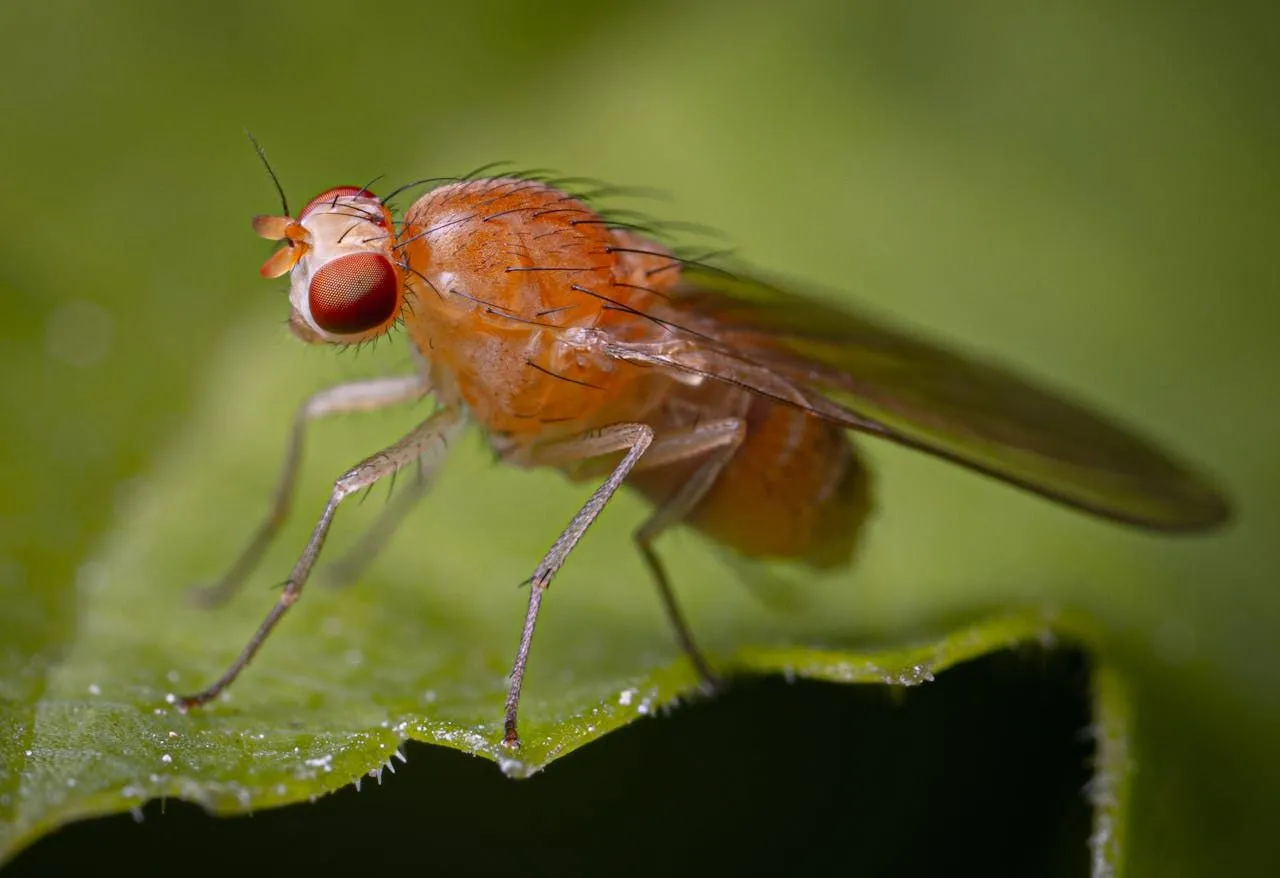
Dragonflies hunt aerially, capturing prey in flight with their spiny, basket-like legs. They typically patrol defined hunting territories — stretches of open water, sunny meadow edges, lawn perimeters — making repeated passes and targeting flying insects in the size range of gnats, mosquitoes, midges, and small flies. House flies (Musca domestica) and other medium-sized flies fall comfortably within their preferred prey size.
A single adult dragonfly consumes dozens to hundreds of insects per day during peak hunting activity.
What Flies and Insects Dragonflies Eat
Dragonflies are generalist aerial predators — they target any flying insect in the appropriate size range that enters their hunting territory. Documented prey includes:
| Prey Category | Common Examples | Pest Status |
|---|---|---|
| Mosquitoes | Aedes, Culex, Anopheles spp. | Major pest |
| Midges and gnats | Fungus gnats, biting midges (no-see-ums) | Pest |
| House flies | Musca domestica | Major pest |
| Blow flies | Blue bottle, green bottle flies | Pest |
| Fruit flies | Drosophila spp. | Pest |
| Crane flies | Tipula spp. | Minor nuisance |
| Flying ants | Carpenter ants, fire ants on mating flights | Pest |
| Winged aphids | Various species | Agricultural pest |
| Non-pest flies | Various Diptera | Neutral |
The key practical point is that dragonflies do not distinguish between "pest" and "non-pest" flying insects — they target any suitable flying prey. In areas where dragonfly populations are robust, reductions in mosquito and small fly populations are measurable and documented. The Smithsonian Institution has highlighted dragonfly predation on mosquitoes as a genuinely significant ecosystem service in wetland and riparian areas.
Dragonflies vs. Damselflies
Dragonflies (suborder Anisoptera) are often confused with damselflies (suborder Zygoptera). Both belong to Odonata and are beneficial predators, but they differ in several ways:
- Wings at rest: Dragonflies hold wings horizontally; damselflies fold wings along the body
- Eye shape: Dragonfly eyes meet or nearly meet at the top of the head; damselfly eyes are separated
- Body build: Dragonflies are stockier and more robust; damselflies are slender
- Hunting range: Dragonflies are more aerial and wide-ranging; damselflies tend to hunt closer to vegetation
Both are predators of pest insects and should be welcomed. Damselflies are particularly effective against small flying insects near pond margins and wetland vegetation.
Habitat Requirements: What Dragonflies Need
Dragonflies have obligate requirements that must be met before they will establish on your property. Simply wanting dragonflies present is not sufficient — the habitat must support their complete life cycle.
Water for Breeding
Dragonfly larvae (naiads) are aquatic. Females oviposit into water or aquatic plants, and larvae develop in water for 1 to 4 years before metamorphosing into adults. Without a suitable water body — even a small one — dragonflies can visit your property but will not establish a resident population.
Suitable water features include:
- Ponds: Even a small garden pond of 4 to 6 feet diameter and 18 to 24 inches depth can support dragonfly breeding. Deeper water (24+ inches) resists winterkill in cooler climates
- Water gardens: Planted with aquatic vegetation — cattails, arrowhead, water lilies, rushes — these support both the aquatic naiad stage and provide emergence surfaces for metamorphosis
- Rain gardens and detention basins: Seasonally flooded areas with aquatic vegetation support some dragonfly species adapted to temporary water bodies
- Natural ponds and wetlands: Properties adjacent to natural water will always have higher dragonfly activity than isolated upland sites
Avoid ponds with fish populations that are too dense — fish consume dragonfly naiads and can prevent establishment. A mix of aquatic vegetation and fish-free zones gives naiads refuge.
Sunny Open Space
Adult dragonflies are ectothermic — they warm themselves by basking in sunlight. They hunt in open, sunny areas and avoid heavily shaded environments. A yard dominated by dense tree canopy with no sunny patches provides inadequate thermal conditions for hunting dragonflies. Open lawn areas, garden beds with low vegetation, and sunny pond edges are all suitable hunting habitat.
Perching Sites
Dragonflies are perch hunters that make forays from elevated perches to intercept prey. They prefer bare, exposed perches with good sightlines: the tips of plant stems, small branches overhanging open areas, bamboo stakes, and wire fencing. Installing 2- to 3-foot wooden stakes around a garden pond edge provides immediate perching habitat.
Minimal Pesticide Use
Dragonflies are sensitive to the same broad-spectrum insecticides that kill flies. Pyrethroid-based yard treatments, mosquito fogging, and other broad-spectrum insecticide applications kill adult dragonflies, dragonfly naiads in water (particularly important for water-applied mosquito larvicides at higher concentrations), and the prey insect populations that sustain dragonfly hunting.
This creates an important trade-off: mosquito fogging may reduce mosquitoes temporarily while eliminating the dragonfly populations that would suppress them long-term. Our natural fly repellents guide covers approaches compatible with maintaining beneficial insect communities.
Attracting Dragonflies to Your Property
Create or Enhance a Water Feature
If you don't have water on your property, installation of even a small pond is the single most impactful step. Key design elements:
- Varied depth: Shallow margins (6–12 inches) and deeper center sections (18–30 inches) support different naiad species and provide temperature variation
- Aquatic and emergent vegetation: Cattails, pickerel weed, arrowhead, and bulrushes at the margin provide egg-laying substrate and emergence structures; submerged plants like hornwort oxygenate the water
- Sun exposure: Position the pond where it receives at least 6 hours of direct sunlight daily
- No liner overhangs: Smooth overhanging liner edges prevent naiads from climbing out to metamorphose; create a gradual, rough-textured shoreline slope instead
Plant to Support Prey Insects
Dragonflies need prey — and prey needs plants. A garden with diverse flowering species supports populations of gnats, midges, and small flies that sustain dragonfly hunting. This is a complementary relationship: plants that repel flies positioned near the house reduce indoor pest pressure, while diverse flowering plants elsewhere in the garden support the prey insect base that keeps dragonflies returning.
Maintain Buffer Zones Near Water
Leave some areas of tall grass, sedges, and native vegetation around any water feature. These areas support the terrestrial prey insects that dragonflies hunt away from the water and provide resting habitat during cooler periods.
In my 15 years of pest management in central Florida, dragonflies are a constant presence during site inspections — particularly near properties with natural ponds, retention basins, or even large ornamental water features. I've watched darner dragonflies (Anax junius) systematically clear the air column above a client's swimming pool, catching flies and midges on each pass. On properties where clients want to reduce pesticide use while managing flying insects, habitat enhancement for dragonflies is always part of the conversation. It's one of the few truly no-downside recommendations in pest management: you add a water feature and some native plants, and you get one of the most capable aerial predators on Earth working for free.
Limitations of Biological Control by Dragonflies
Dragonflies are powerful allies, but they have real limitations as a pest control strategy:
- Range: Dragonflies patrol defined territories and cannot be directed to target specific areas of a property
- Population lag: Establishing a dragonfly population through habitat creation takes 1 to 3 years — naiads must complete aquatic development before adults emerge
- No indoor effect: Dragonflies hunt outdoors and provide no benefit for flies and disease concerns inside the home
- Weather dependency: Dragonflies are most active in warm, sunny conditions. During cloudy or cool periods, they are less active and fly hunting activity declines
- Cannot eliminate infestations: Dragonflies reduce fly populations within their hunting range but cannot eliminate an infestation driven by a nearby breeding source — a garbage dump, manure pile, or decaying animal
Biological control by dragonflies works best as a long-term, property-scale complement to source reduction and targeted control measures, not as a replacement for them. What attracts flies in the first place determines whether dragonfly predation makes a meaningful dent in populations or is simply overwhelmed by the breeding source continuously producing new adults.
How to Identify
Confirming dragonfly presence and active hunting in your yard requires knowing what to look for. Adult dragonflies are robust fliers with two pairs of wings held horizontally at rest, large compound eyes that meet or nearly meet at the top of the head, and body lengths ranging from 25 to 85 millimeters depending on species. They are most active during sunny, warm mid-morning through early afternoon hours, patrolling defined airspace above ponds, open lawn areas, and garden edges. Repeated flight paths returning to the same perch indicate a resident hunting territory rather than a passing individual. Exuviae (shed larval skins) clinging to emergent plant stems or pond edges confirm successful reproduction in your water feature. Naiads in pond water are flat, drab, and broad-abdomened, found on submerged vegetation; their presence confirms larval development is occurring. Finding exuviae together with active adults overhead indicates your habitat is supporting a self-sustaining population rather than transient visitors passing through.
Prevention
Preventing the habitat loss that eliminates dragonfly populations from residential properties means avoiding the practices most commonly responsible for their disappearance. Minimize broad-spectrum insecticide use in and around water features; pyrethroid-based yard treatments and mosquito fogging kill adult dragonflies and aquatic naiads, eliminating populations that may have taken years to establish. If mosquito management is necessary, use Bti-based larvicides in standing water rather than broad-spectrum sprays, since Bti selectively targets mosquito and black fly larvae with minimal impact on dragonfly naiads. Keep pond water healthy by maintaining aquatic vegetation, avoiding over-fertilization that causes algal blooms, and not overstocking fish that prey on naiads. Prevent sediment accumulation that reduces naiad habitat quality over time. In drought conditions, maintain pond water levels to prevent naiad desiccation. Preserving native vegetation buffers around water features provides the resting and thermoregulation habitat that keeps resident dragonflies actively hunting through the season.
Main Causes
Indoor flies activity is driven by accessible breeding material and warmth. House flies and blow flies breed in garbage, pet waste, compost, and dead animals; fruit flies breed in overripe produce, drain biofilm, fermenting liquids, and unrinsed recycling; drain flies breed in the gelatinous film inside infrequently used drains; phorid flies breed in broken sewer lines and decomposing material under slabs. Adults find their way inside through torn screens, gaps around doors, vents, and any opening to the outside. Warm weather accelerates the entire life cycle, and a sustained population always points to an unaddressed source either inside the structure or close enough that adults keep arriving in volume.
Risk and Severity
Flies are mechanical disease vectors, picking up pathogens from feces, decomposing material, and garbage on their bodies and depositing them on food and surfaces. House flies in particular regurgitate digestive fluids when feeding, contaminating any surface they land on. Documented transmissible pathogens include Salmonella, E. coli, Shigella, and Campylobacter. Blow flies in homes signal a dead animal in or near the structure — a secondary health concern from decomposition gases and additional pest activity around the carcass. Biting flies (horse flies, stable flies, black flies) deliver painful bites and can trigger allergic reactions; in some regions they transmit parasites or bacterial infections. Children, elderly, and immunocompromised individuals face elevated risk.
Solutions and Actions
Effective fly control requires locating and eliminating the breeding source — adult-only treatments produce only temporary relief. For house flies: remove and seal garbage, clean pet waste daily, manage compost properly, and check for dead animals in wall voids or attics if blow flies are present. For fruit flies: discard overripe produce, clean drains with enzymatic cleaner weekly, rinse recycling, and empty kitchen compost containers daily. For drain flies: brush drain walls thoroughly and treat with enzymatic drain cleaner weekly for at least three weeks. For phorid flies: investigate for broken sewer lines or moisture intrusion under slabs. Adult control through sticky cards, UV light traps, and targeted residual sprays supplements but never substitutes for source elimination.
Frequently Asked Questions
What is the best type of pond for attracting dragonflies?
A naturalistic pond with varied depth, abundant aquatic and emergent vegetation, and at least 6 hours of daily sun consistently attracts the most dragonfly species. Avoid formal, bare-edged ponds with no vegetation — they provide insufficient habitat for naiad development and lack the prey insect base that sustains adult dragonflies.
Will dragonflies harm butterflies or other beneficial insects?
Yes, to some degree — dragonflies are generalist predators and will opportunistically catch butterflies, bees, and other beneficial insects along with pest species. In practice, the impact on beneficial insect populations in a diverse garden is generally small compared to the benefit of predator presence, but it is worth noting that dragonflies are not surgically targeted pest control agents.
How do I tell if dragonflies are breeding in my pond?
Look for exuviae — the shed larval skins left clinging to emergent plant stems or the pond edge after naiads metamorphose into adults. These papery, insect-shaped husks indicate successful naiad development and adult emergence. Finding exuviae is definitive evidence that your pond is supporting dragonfly reproduction. Adult dragonflies emerging from water and pumping their wings before their first flight are equally diagnostic.
Do dragonflies bite or sting?
Dragonflies have mandibles capable of biting and will bite if carelessly handled, but they rarely bite humans voluntarily. They have no stinger. Handling a large dragonfly like a darner species with bare fingers may result in a mild pinch; it is not medically significant. They pose no meaningful risk to people or pets.
Sources: Smithsonian Institution — Dragonfly Predation Research | Cornell University Entomology
Continue reading:
The Complete Guide to Flies: Identification, Prevention & Elimination →Sources & Further Reading
- House Flies — Pest Notes — University of California Statewide IPM Program
- Fruit Flies in the Home — Penn State Extension
- Controlling Pests Safely — U.S. Environmental Protection Agency