Part of the The Complete Guide to Wasps: Identification, Species, Prevention & Removal guide.
On the Schmidt Pain Index — the scale entomologist Justin Schmidt developed by allowing himself to be stung by hundreds of insect species — the tarantula hawk wasp (Pepsis grossa and Pepsis thisbe) earns a level 4 rating, the second highest possible. Schmidt's own description: "Blinding, fierce, shockingly electric. A running hair drier has just fallen into your bubble bath." The pain peaks in roughly three to five minutes and fades significantly within 10 minutes. The experience is intense but brief. Understanding what produces it — and what doesn't — is the key to putting tarantula hawks in proper perspective.
For a comprehensive overview, see our Complete Guide to Wasps.
What Are Tarantula Hawk Wasps?
Tarantula hawks belong to the family Pompilidae (spider wasps), genus Pepsis, with a few species in the closely related genus Hemipepsis. They are the largest members of Pompilidae, and among the largest wasps found anywhere in North America. Pepsis grossa and Pepsis thisbe are the two species most commonly encountered in the American Southwest and West.
Their common name is literal: tarantula hawks hunt tarantulas. A female locates a tarantula — often at or near its burrow — engages it, and delivers a precisely targeted sting to the underside of the cephalothorax where the cuticle is thin and the ventral nerve ganglia are accessible. The tarantula is paralyzed almost instantly. The wasp then drags the spider into a burrow, lays a single egg on its abdomen, seals the chamber, and moves on. The larva that hatches will consume the paralyzed-but-living tarantula over several weeks.
Physical Appearance
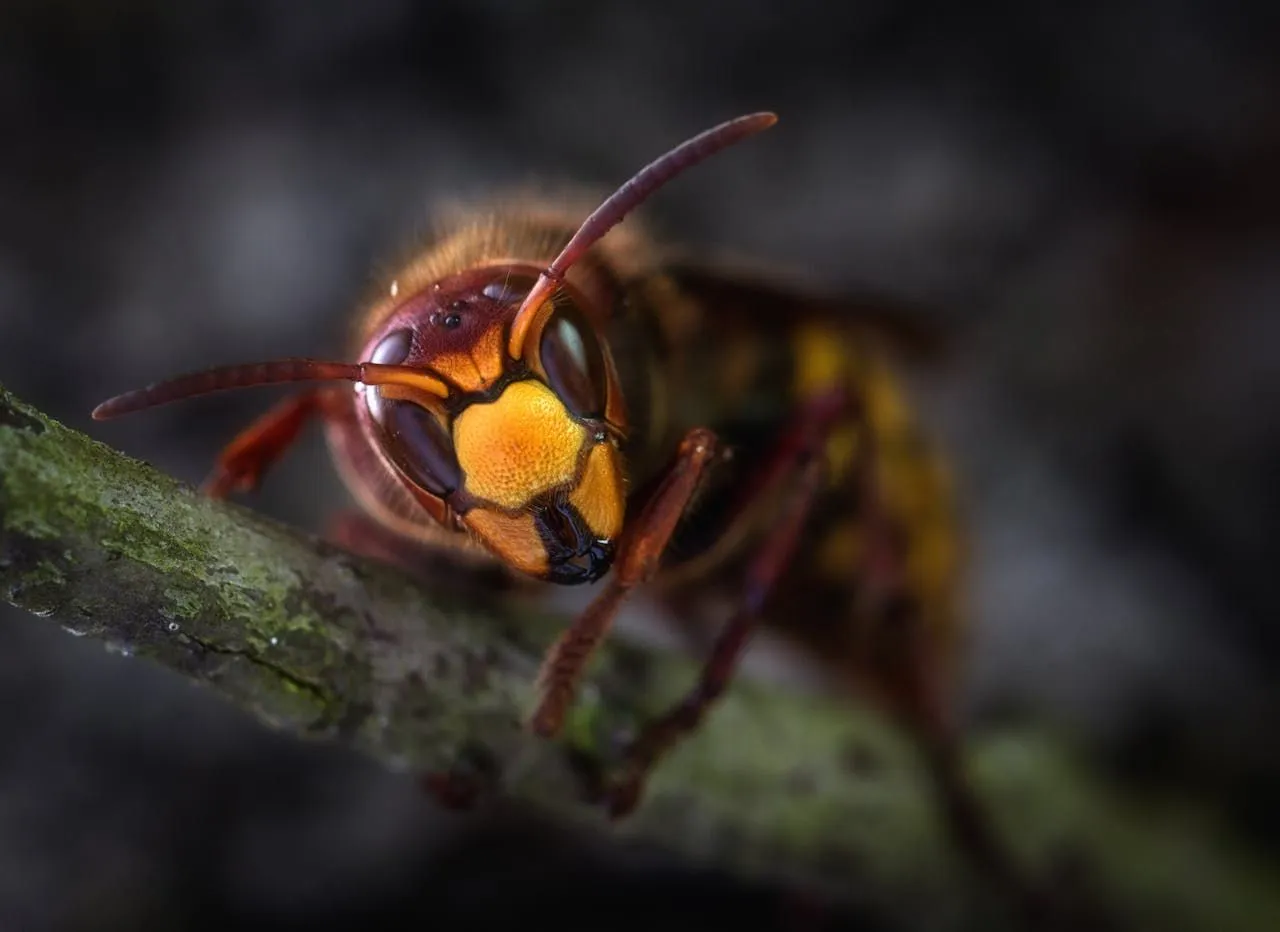
Tarantula hawks are impossible to mistake once you've seen one. Female Pepsis grossa measure 1.5 to 2 inches in body length, making them roughly the size of an adult thumb from the second joint. The body is a glossy, deep blue-black; the wings are bright rust-orange to reddish, creating a bold warning color pattern visible from several feet away.
The legs are long, spiny, and built for gripping — useful both for wrestling tarantulas and for climbing out of burrows while dragging prey significantly heavier than the wasp itself. The antennae are long; females curl them slightly at the tips. Males are slightly smaller than females and lack the curved ovipositor/stinger apparatus that makes females so formidable.
The bright orange wings are not decorative. They are aposematic coloration — a warning signal that, because tarantula hawk stings are genuinely memorable, predators learn to associate with an unpleasant experience and avoid accordingly.
Range and Habitat
Tarantula hawks are found throughout the American Southwest, Great Plains, and into Central and South America. In the United States, they are most abundant in desert and semi-arid environments: the Sonoran Desert, Chihuahuan Desert, and lower elevations across Texas, New Mexico, Arizona, California, Utah, and Nevada. They are the official state insect of New Mexico.
Adults require flowering plants for nectar — they feed on flowers, particularly milkweed (Asclepias species) and other large, open-faced blooms — so they're most commonly seen in late spring through early fall when desert wildflowers are available. They're active during the hottest part of the day, a time when most predators are resting, which reduces the predation risk to foraging adults.
The Sting: What Actually Happens
According to NIH research on Hymenoptera venom, tarantula hawk venom contains a complex mixture of peptides and proteins that act on mammalian pain receptors directly rather than causing significant tissue destruction or systemic toxicity. This is key to understanding why tarantula hawk stings are so painful and so brief: the venom is optimized as a deterrent against vertebrate predators, not as a tissue-damaging weapon.
The practical experience of a tarantula hawk sting in humans:
- Pain onset is essentially immediate
- Intensity peaks within one to two minutes
- The affected area may feel numb or electric rather than burning
- Significant reduction in pain within 5 to 10 minutes
- Residual soreness or sensitivity may persist for an hour or more
- Local swelling is typically mild compared to yellow jacket stings
The standard advice from entomologists who study these wasps is darkly humorous but medically sound: lie down, don't move, and wait. Physical activity increases blood circulation and distributes the venom more widely, intensifying pain. Staying still lets the venom clear from the injection site faster.
How to Treat a Tarantula Hawk Sting
For most people, tarantula hawk stings require only basic first aid. See our full guide on wasp sting treatment for complete instructions, but the core steps:
- Move away from the area where you were stung — the wasp won't pursue you, but getting clear of the area reduces the chance of additional stings.
- Wash the sting site with soap and water.
- Apply a cold pack to reduce localized inflammation.
- Take an oral antihistamine (cetirizine or diphenhydramine) to address any histamine-mediated itching.
- Use ibuprofen or acetaminophen for residual soreness.
The venom does not require extraction — tarantula hawks, like all wasps, have smooth stingers and don't leave them behind. There is no barbed stinger to remove.
Allergic reactions to tarantula hawk stings are possible. Anyone who develops symptoms beyond the local sting site — widespread hives, difficulty breathing, throat swelling, dizziness, or nausea — should treat this as a medical emergency. See our guides on wasp sting allergy and anaphylaxis from wasp stings for emergency protocols. According to the NPMA, Hymenoptera sting allergy is the second most common cause of anaphylaxis-related emergency department visits in the United States.
Behavioral Reality: The Sting Risk Is Low
Here is the critical nuance that separates understanding tarantula hawks from fearing them: female tarantula hawks are extraordinarily reluctant to sting humans. Their venom is their most valuable resource — it's what paralyzes tarantulas and feeds their offspring. They don't spend it casually.
Females are focused on finding tarantulas, nectaring on flowers, and excavating burrows. They are not territorial, they don't patrol areas defensively, and they don't sting without direct physical provocation. The practical risk profile is: don't handle them, don't step on them, and don't pin them against your skin by accident. Left alone, tarantula hawks pass within inches of people every day without incident.
Males are entirely harmless — they have no stinger, they spend their time nectaring and patrolling flowering plants for females, and their life strategy involves nothing that brings them into conflict with people.
In my 15 years of pest management work, I've seen tarantula hawks in southern Texas and Arizona on extended field visits. The combination of their size, color, and reputation makes every encounter feel significant. But watching a female drag a tarantula twice her apparent weight backward across the desert floor, I was struck by how completely indifferent to me she was. Her entire focus was on the tarantula.
Tarantula Hawk Sting vs. Other Painful Stings
| Species | Schmidt Pain Scale | Pain duration | Tissue damage |
|---|---|---|---|
| Tarantula hawk (Pepsis grossa) | 4 | 3–5 minutes peak | Minimal |
| Bullet ant (Paraponera clavata) | 4+ | 12–24 hours | Minimal |
| Paper wasp (Polistes spp.) | 3 | 15–30 minutes | Mild |
| Yellow jacket (Vespula spp.) | 2 | 10–20 minutes | Moderate |
| Honeybee (Apis mellifera) | 2 | 5–10 minutes | Moderate (barbed stinger) |
Ecological Role
Tarantula hawks are not pests — they're a specialized predator at the top of an interesting food web. By keeping tarantula populations in check in desert environments, they play a structural role in arid ecosystem food webs. Their adults are pollinators, visiting flowers for nectar throughout the summer season, including native milkweeds and other plants that support a broader community of pollinators and insects.
For context on how wasp predation functions as pest control more broadly, see our guide on wasp stings and the ecological role wasps play in pest management.
Closing
Tarantula hawks are magnificent insects given an outsized reputation because of what humans experience when stung. The sting is genuinely among the most painful an insect can deliver in North America. But it's also brief, doesn't cause lasting harm in most people, and occurs only when someone directly handles or accidentally crushes a female. The far more common experience of tarantula hawk encounters is watching one move through desert scrub or nectar on a milkweed flower — which is well worth the watch.
Main Causes
Wasps build nests on structures because eaves, soffits, attic vents, deck rafters, wall voids, shed interiors, and dense shrubbery provide protected anchor points and easy access to forage. Queens emerging in spring seek out these locations, and a single founding queen establishes a colony that grows from a few cells in April to hundreds or thousands of workers by late summer. Indoor encounters happen when nests in wall voids or attics route through entry points, when foragers come inside through open doors and damaged screens chasing food and water, and during fall when colonies are at peak size and most defensive. Outdoor food and sweet drinks, ripening fruit, garbage, and uncovered pet food all amplify foraging pressure around occupied spaces.
How to Identify
Identify the species and locate the nest before any control action. Paper wasps build open, downward-facing umbrella-shaped combs under eaves, deck railings, playground equipment, and grill covers. Yellow jackets build enclosed papery nests in wall voids, attics, ground holes, and dense shrubs. Bald-faced hornets build large basketball-sized gray paper nests hanging from tree branches and structure corners. Mud daubers build small mud tubes on walls and ceilings and are non-aggressive. Watch returning workers at dusk to pinpoint nest entry points, especially for ground and wall-void nests that are otherwise invisible. Species, nest size, and nest location together determine whether removal is straightforward, hazardous, or requires professional intervention.
Risk and Severity
Wasp stings are painful, common, and occasionally life-threatening. Most stings produce localized pain and swelling and resolve within hours, but multiple stings or stings in someone with venom allergy can trigger anaphylaxis — a medical emergency requiring epinephrine and emergency care. Yellow jackets and hornets are particularly aggressive when nests are disturbed and can deliver dozens of stings to a single person, especially with ground-nesting yellow jackets where mowing or yard work triggers mass defensive responses. Stings inside the mouth or throat from swallowed wasps can produce dangerous airway swelling regardless of allergy status. Risk scales with nest size, nest location relative to occupied space, household members with venom allergy, and time of year — late summer is peak risk.
Solutions and Actions
Treat wasp nests at dawn or dusk when most workers are inside and least active, wearing protective clothing covering all skin, eyes, and face. For paper wasp nests in accessible locations, use a wasp and hornet jet spray rated for the species from a safe distance, then remove the dead nest material the next day to discourage rebuilding. For yellow jacket nests in wall voids, ground holes, or attics — and for any large nest with visible heavy traffic — use a licensed professional, because these nests harbor hundreds to thousands of workers and disturbing them produces mass stinging responses. Never plug a wall-void nest entry without first eliminating the colony, because trapped workers will tunnel through interior wall surfaces seeking exit.
Prevention
Prevention focuses on denying nest sites and reducing forage attractants. Inspect eaves, soffits, attic vents, deck railings, sheds, and outbuildings in early spring and brush down any starting nests while they are still small enough for a single queen to be the only occupant. Seal cracks larger than a quarter inch in siding, soffit gaps, and around utility penetrations to block wall-void access. Cover outdoor garbage cans and recycling with tight-fitting lids, keep sweet drinks and food covered during outdoor meals, and clean fruit drops from yards promptly. Maintain window and door screens and add door sweeps. Run a targeted residual treatment under eaves and along soffits in early summer where paper wasp nesting has been a recurring problem.
Frequently Asked Questions
Are tarantula hawk wasps aggressive?
No. Female tarantula hawks are focused on finding tarantulas and nectaring on flowers. They don't patrol territory, don't defend nests communally, and don't sting unless directly handled or accidentally pinned against skin. Males have no stinger at all. Left alone, they pose no practical risk to people nearby.
Where are tarantula hawks found in the US?
Primarily in the American Southwest: Arizona, New Mexico, Texas, Nevada, Utah, and Southern California. They're most abundant in desert and scrubland environments where tarantulas are also present. Pepsis species have been recorded as far east as Kansas and as far north as Wyoming, but sightings become less common outside the Southwest. New Mexico designated the tarantula hawk as its official state insect in 1989.
What should I do if I'm stung by a tarantula hawk wasp?
Lie down or sit still — activity increases pain by improving venom distribution. Wash the area, apply a cold pack, and take an oral antihistamine. For most people the worst of the pain passes within five to ten minutes. Monitor for signs of allergic reaction — widespread hives, throat swelling, difficulty breathing, or dizziness — and treat any such symptoms as a medical emergency. See our full guide on wasp sting treatment for detailed first aid steps.
Do tarantula hawks kill tarantulas immediately?
No. A female tarantula hawk paralyzes the tarantula rather than killing it outright. The living but immobilized spider stays fresh underground while the wasp larva feeds. This is why the sting must hit the spider's nervous system so precisely.
Sources & Further Reading
- Yellowjackets and Other Social Wasps — University of California Statewide IPM Program
- Stinging Insects — U.S. National Institute for Occupational Safety and Health
- Anaphylaxis — U.S. National Institute of Allergy and Infectious Diseases