Part of the The Complete Guide to Mosquitoes: Identification, Prevention & Control guide.
At dusk over a lakefront or coastal marsh, clouds of small flying insects appear and most people assume they are mosquitoes. Often they are midges. The two groups are genuinely different insects with different biology, different biting behavior, and different implications for control. Mistaking one for the other leads to frustration when treatment misses the actual pest entirely.
For a comprehensive overview, see our Complete Guide to Mosquitoes.
What Are Midges?
"Midge" is a collective term covering several families of small dipteran flies. The two groups most commonly encountered as outdoor nuisances are:
- Non-biting midges (Chironomidae): These look strikingly similar to mosquitoes at a glance but do not bite. They form large mating swarms near water bodies, are strongly attracted to lights at night, and have aquatic larvae that live in lake and pond sediment.
- Biting midges (Ceratopogonidae, also called no-see-ums or punkies): True biters with disproportionately intense bites for their tiny size. They are capable of passing through standard window screen mesh, which makes exclusion more difficult than for mosquitoes.
Understanding which group you are dealing with determines both the urgency of control and the appropriate response strategy.
Visual Identification: Mosquito vs. Midge
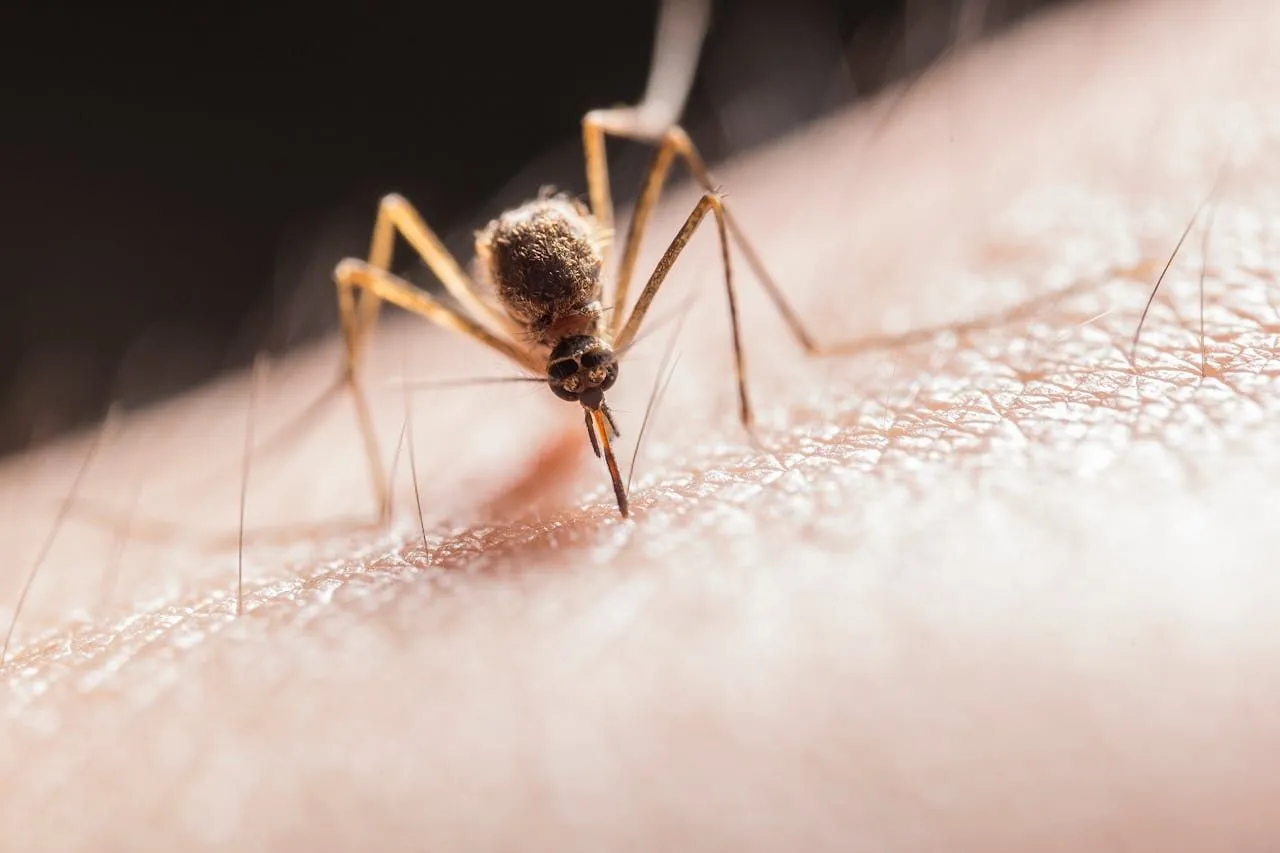
The fastest diagnostic is the mouthpart. A long, needle-like proboscis projecting forward from the head means mosquito. No prominent projecting mouthpart means midge.
| Feature | Mosquitoes | Non-biting Midges | Biting Midges (No-see-ums) |
|---|---|---|---|
| Body length | 3 to 6 mm | 1 to 10 mm | 1 to 3 mm |
| Proboscis | Long, forward-projecting needle | None prominent | Short piercing mouthparts |
| Wings | Scaled (fuzzy, powdery appearance) | Clear, unscaled | Clear, often with spots |
| Male antennae | Feathery (plumose) | Very prominent plumose | Plumose |
| Resting posture | Rear end raised | Parallel to surface | Parallel to surface |
| Bites humans? | Females only | No | Females only |
Wing Scales: The Definitive Check
Under any magnification, mosquito wings have a distinctly fuzzy or powdery texture from tiny scales covering the wing veins. Midge wings are clear and glassy with no scales. A phone macro camera or a basic hand lens settles the identification definitively if you have a specimen to examine.
Behavior and Habitat
Activity Patterns
Mosquito activity varies by species: Aedes mosquitoes bite throughout the day, while Culex and Anopheles are most active from dusk through the night. Non-biting midges are strongly crepuscular, swarming densely at dusk and dawn over water bodies. Biting midges peak at dawn and dusk and become much less active when wind speed exceeds 5 to 7 miles per hour, which is one practical outdoor management tool.
Breeding Habitat
Mosquito larvae require standing water of almost any kind, from a bottle cap to a neglected swimming pool. Non-biting midge larvae live in the sediment of lakes, ponds, streams, and coastal waters. Their large swarms near marinas and lakeshores typically indicate a productive aquatic ecosystem rather than a pest problem requiring intervention. Biting midge larvae develop in moist, organic-rich soil and sediment at the margins of water bodies, particularly in coastal areas and around tidal flats.
Bite Differences
If you are being bitten, the bite itself provides diagnostic information.
Mosquito bites produce a single raised wheal (welt) with a central puncture point. Itching is pronounced and the welt typically resolves within hours to a few days. Some individuals with heightened sensitivity develop larger, longer-lasting reactions.
Biting midge bites are often multiple and clustered in a small area. They produce intense, disproportionate itching for the small wound size and may leave tiny hemorrhagic (pinprick-like) marks at each bite site. The reaction can persist for several days and sometimes develops into a small papule. Non-biting midges, by definition, leave no bites whatsoever.
Disease Implications
The distinction between midges and mosquitoes has direct relevance to public health risk:
- Mosquitoes transmit viruses and parasites including West Nile virus, dengue, Zika, malaria, and chikungunya. The CDC tracks domestic mosquito-borne disease transmission and publishes updated guidance on which species pose the greatest risk in each region of the United States. See our mosquito-borne diseases guide for a complete overview of domestic and travel-related risks.
- Biting midges (Ceratopogonidae) transmit bluetongue virus and epizootic hemorrhagic disease to livestock and deer, and certain filarial worm species in tropical regions. The USDA monitors biting midge populations as an agricultural pest affecting cattle and deer herds across the southern United States. They are not known vectors of human disease in North America.
- Non-biting midges transmit no diseases, though large swarms can trigger respiratory irritation and allergic reactions in sensitive individuals.
Control Strategies
Non-biting Midges
Non-biting midges require no public health control. If nuisance swarming near homes is the concern, switching exterior lighting from white incandescent or standard LED to amber or yellow LED bulbs significantly reduces attraction. These insects are strongly phototactic, and the spectral shift makes a meaningful practical difference without requiring any chemical treatment.
Biting Midges (No-see-ums)
Biting midges are among the most difficult small insects to control because of their size and biology:
- Standard 16-mesh window screens do not exclude biting midges; 20-mesh or finer "no-see-um screens" are needed for meaningful exclusion
- Their small size lets them enter through any gap in screen or weather stripping
- Breeding habitat in moist organic sediment near water bodies is difficult to eliminate without significant environmental disruption
Effective approaches include:
- Repellents: DEET and picaridin repel biting midges effectively; the same products used for mosquito repellent apply to both insects
- Fine-mesh screens: 20-mesh provides meaningful exclusion and is a worthwhile investment in coastal areas with chronic biting midge pressure
- Fan use outdoors: Biting midges are weak fliers and cannot land against a sustained directional breeze; a fan aimed at outdoor seating prevents most landing attempts
- Permethrin-treated clothing: Highly effective for outdoor workers and campers spending extended time in biting midge habitat
Mosquitoes
For mosquito control, a layered approach covering source reduction, Bti larviciding, barrier spray treatment, and personal repellents provides the best results. Our how to get rid of mosquitoes guide covers the full integrated strategy from standing water elimination through professional treatment options.
In my 15 years of pest management in central Florida, midge confusion comes up every spring along lakefront and riverside properties. I have had homeowners spend money on mosquito barrier spray programs that produced no results for their non-biting midge problem, because midges are not affected by the insecticide products used for mosquito adulticide, and the breeding habitat (lake sediment) was never part of the treatment scope. The first step is always correct identification. Catching a specimen in a clear glass, checking for the forward-projecting proboscis, and looking at the wing surface takes less than a minute and determines everything about what to do next.
Midges and mosquitoes are easily confused at a glance but straightforward to separate with the right diagnostic approach. The proboscis check and wing scale examination resolve most identifications quickly and without equipment. Correct identification tells you whether you face a genuine public health concern requiring control, a nuisance that responds to lighting changes, or a biting problem requiring fine-mesh screens and repellents matched to the actual culprit.
Prevention
Prevention strategies differ between mosquitoes and midges, though several approaches work against both insects.
For mosquitoes, complete prevention involves weekly standing-water elimination, monthly Bti treatment of permanent water features, intact window and door screens, and EPA-registered repellents containing DEET or picaridin applied before outdoor activity. Barrier spray treatment of resting vegetation extends protection between source-reduction cycles.
For biting midges (no-see-ums), standard 16-mesh window screens are insufficient - 20-mesh or finer no-see-um screens provide meaningful exclusion because biting midges pass through standard mesh. DEET and picaridin repellents effective against mosquitoes also repel biting midges. Oscillating fans on outdoor seating areas are highly effective for both insects, as biting midges are even weaker fliers than mosquitoes and cannot maintain flight against directional airflow.
Switching outdoor lighting to amber or yellow LED bulbs reduces attraction for non-biting midges without compromising mosquito prevention. No single strategy eliminates all biting insect pressure; layering approaches that address mosquitoes and midges together delivers the most consistent results.
Main Causes
Yard and indoor mosquitoes activity is driven entirely by accessible standing water for larval development. Even small volumes — water in clogged gutters, plant saucers, birdbaths not refreshed weekly, tarps holding rain pools, unused tires, toy buckets, corrugated downspout extensions, and pet bowls — produce hundreds to thousands of adults per container per week. Adults rest in shaded vegetation during the day and emerge at dawn and dusk to seek hosts. They enter homes through torn screens, gaps around doors, and any time exterior doors are propped open in warm weather. Properties next to wetlands, drainage ditches, and shaded woodlots face higher baseline pressure even with clean yards.
How to Identify
Identify the active species and its breeding site before treating. Container-breeding species like Aedes aegypti and Asian tiger mosquitoes are day-biting, prefer artificial containers around homes, and produce eggs that survive months of drying. Culex mosquitoes are dusk-to-dawn biters that breed in standing water with organic content — clogged gutters, ditches, and stormwater catch basins. Walk the entire property and identify every container, depression, and surface holding water for more than a week. A flashlight inspection of standing water at night reveals wriggling larvae and tumbling pupae near the surface, confirming an active breeding site. Indoor activity usually traces to a single nearby breeding source, not to an interior breeding population.
Risk and Severity
Mosquitoes are the most significant vector-borne disease pests in North America. Documented locally transmitted diseases include West Nile virus, Eastern equine encephalitis, La Crosse encephalitis, and St. Louis encephalitis, with periodic outbreaks of Zika, dengue, and chikungunya in southern states. Mosquitoes also transmit canine heartworm, a serious veterinary concern requiring monthly prevention. Severity of bite reactions ranges from minor itching to large local reactions, and rare anaphylactic responses are documented. Risk concentrates in summer evenings, near standing water, and in shaded yards with dense vegetation. Children, the elderly, and immunocompromised individuals face elevated risk for serious illness from mosquito-borne infections, and properties near wetlands face sustained pressure.
Solutions and Actions
Mosquito control hinges on removing breeding water first. Walk the entire property weekly during mosquito season and dump every container, gutter, birdbath, plant saucer, and depression holding standing water. Treat ornamental water features with Bti larvicide (mosquito dunks) which is safe for fish, pets, and people. For yard adult activity, apply a residual insecticide barrier treatment to shaded resting areas — under decks, dense shrubs, fence lines, and woodlot edges. For individual protection during outdoor activity, use EPA-registered repellents containing DEET, picaridin, or IR3535 on exposed skin and treat clothing with permethrin. Inspect and repair window and door screens. Properties next to wetlands or drainage features may benefit from a professional barrier treatment program during peak season.
Frequently Asked Questions
Do midge bites look the same as mosquito bites?
Not exactly. Mosquito bites typically produce a single raised wheal with a central puncture and pronounced itching. Biting midge bites are often multiple, clustered, intensely itchy, and may show tiny hemorrhagic pinprick marks at each bite site. Non-biting midges leave no bites at all, which is the simplest distinguishing outcome of all.
Can midges spread disease to humans in North America?
No human diseases are transmitted by midges in North America. Biting midges are significant agricultural pests, transmitting bluetongue and epizootic hemorrhagic disease to livestock and deer, but they are not known human disease vectors in this region. Non-biting midges transmit no diseases, though large swarms can trigger allergic respiratory reactions in sensitive people.
Why are biting midges worse near water?
Biting midge larvae develop in moist, organic-rich sediment at the margins of lakes, ponds, marshes, and tidal flats. Adults emerge near these habitats and remain relatively close to their breeding sources. Coastal areas, estuaries, and lakefronts in Florida, the Gulf Coast, and similar regions face the highest biting midge pressure during warm months, which is why they are a more common complaint in those specific environments.
Why does the identification change treatment?
Non-biting midges swarm near lights and water but do not bite, while no-see-ums pass through standard screens and require finer mesh. Mosquito source reduction will not fix lake-sediment midge swarms.
Continue reading:
The Complete Guide to Mosquitoes: Identification, Prevention & Control →Sources & Further Reading
- About Mosquitoes — U.S. Centers for Disease Control and Prevention
- Insect Repellents Use and Safety — U.S. Environmental Protection Agency
- Vector-Borne Diseases — World Health Organization