Part of the The Complete Guide to Wasps: Identification, Species, Prevention & Removal guide.
Every fall, a biological clock inside a wasp colony runs out. The queen's production of new reproductives — virgin queens and males — marks the beginning of the end for the colony that produced them. These new individuals exist for one purpose: to mate, disperse, and carry the colony's genes into the next year. The colony itself doesn't survive. The mated queens do. Understanding this cycle explains nearly everything distinctive about wasp behavior in late summer and fall — including why they become so aggressive right before disappearing entirely.
For a comprehensive overview, see our Complete Guide to Wasps.
The Annual Colony Cycle: A Brief Overview
Social wasps in North America operate on an annual cycle. Each spring, a single overwintered, fertilized queen emerges from hibernation, selects a nest site, begins building, and lays the first eggs entirely alone. By midsummer, the colony reaches its maximum size — hundreds to several thousand workers, depending on species — with a steady-state economy of foraging, larval care, and nest expansion.
In late summer, the colony's reproductive priorities shift. New queens (gynes) and males (drones) are produced. These reproductives mate, the new queens overwinter, and everyone else in the colony — old queen, workers, and males — dies when cold arrives. The old nest is abandoned and never reused.
This annual cycle is the defining feature of temperate social wasps, and mating is the critical pivot around which the entire colony calendar turns. For a detailed breakdown of all life stages, see our guide on the wasp life cycle.
Production of New Queens and Males
The shift toward reproductive output begins when day length shortens and temperatures drop in late summer — environmental cues that signal seasonal change. The colony starts producing new queens (gynes) and males rather than additional workers. The two sexes develop from different types of eggs:
- New queens: Develop from fertilized (diploid) eggs laid in larger, specially provisioned cells. They are fed more generously than workers throughout their larval development, which directs them toward full reproductive development rather than the worker phenotype.
- Males: Develop from unfertilized (haploid) eggs in cells that are typically arranged at the nest periphery. Males are slightly smaller than queens in most species and lack a functional stinger.
According to Penn State Extension, the ratio of workers to reproductives produced shifts dramatically in August and September, with late-season colonies devoting most of their brood cells to reproductives rather than workers. This is why late-season nests often look less active at the cell level — the colony isn't building more workers, it's investing in the future.
Mating Behavior: When and Where It Happens
Mating in social wasps doesn't happen inside the nest. New queens and males emerge from the colony and disperse before mating — a dispersal pattern that promotes outbreeding and prevents inbreeding between siblings raised in the same colony.
Males typically emerge before new queens and begin aggregating in areas where queens are likely to pass — often elevated locations like hilltops, prominent trees, or large shrubs. This is called hilltopping or lekking behavior, and it's widespread across Hymenoptera. Males patrol these sites and compete for position, intercepting virgin queens that arrive to mate.
Mating itself is brief — typically seconds to a few minutes per copulation. A new queen may mate with one or several males in rapid succession before dispersing to find a hibernation site. She stores the received sperm in her spermatheca (a specialized sperm storage organ), where it will remain viable for the following spring and beyond. A queen paper wasp (Polistes species) typically mates once; yellow jacket (Vespula species) queens may mate multiply, acquiring sperm from several males that she will use selectively throughout her laying career.
Males die after mating. They have no role in colony life beyond sperm transfer, and they don't have functional stingers, so they pose no sting risk. The males you see hovering around flowers or vegetation in early fall are typically this mating-dispersal cohort — not aggressive, just temporary.
Where New Queens Go After Mating
After mating, a new queen's immediate priority is finding a hibernation site before temperatures drop too far. She must accumulate fat reserves — feeding actively on nectar and other carbohydrates — before entering a dormant state that will last through winter.
Overwintering sites vary by species. Paper wasp queens (Polistes species) often overwinter in dense vegetation, under bark, inside hollow stems, or in sheltered cavities around structures — including the interiors of sheds, garages, and wall voids. Yellow jacket queens typically seek underground or buried sites. Bald-faced hornet queens use sheltered bark crevices and similar microhabitats.
According to UF IFAS, in Florida and the warm Southeast, wasp overwintering is abbreviated compared to northern states — queens may enter only a partial dormancy during mild winters, and some colonies in South Florida can persist year-round without the hard winter kill that terminates colonies further north.
In my 15 years of pest management work in central Florida, I've found overwintering paper wasp queens in some surprising places: the hollow interior of decorative bamboo fence sections, rolled-up garden hoses left in garages, and the space between stacked outdoor furniture cushions. The common thread is a sheltered microenvironment with relatively stable temperatures through the cool months.
The Fall Die-Off
As new queens disperse to overwinter and males die after mating, the colony enters its terminal phase. Workers become increasingly disorganized — foraging trips become erratic, larval care becomes inconsistent, and the nest may fall into partial disrepair. The remaining queen's egg production declines sharply as her spermatheca depletes and her reproductive physiology ages.
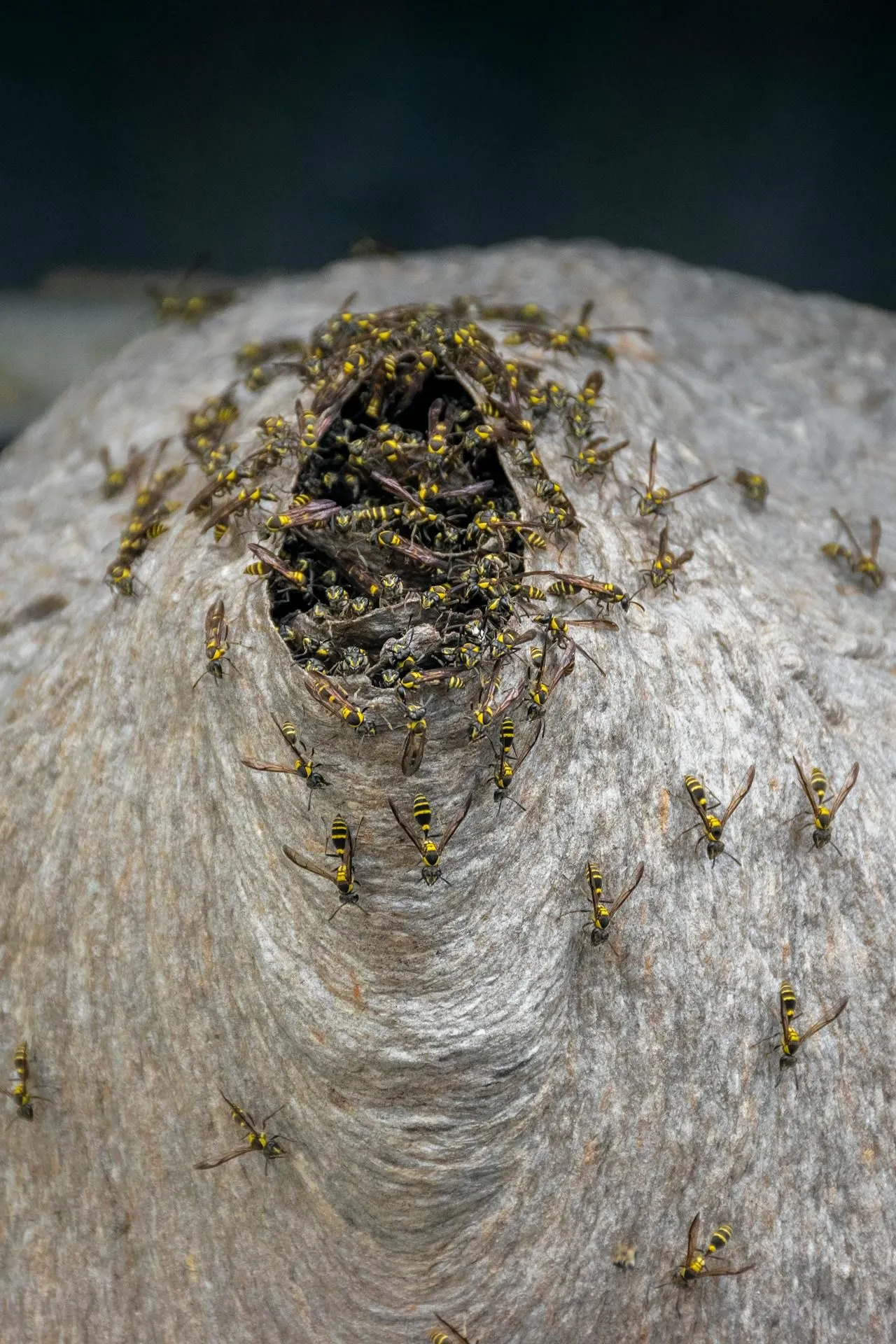
Workers in this period exhibit the irritable, unpredictable behavior that makes late summer and early fall the most dangerous time to encounter a yellow jacket nest. Colony social cohesion that normally regulates worker aggression is breaking down. Workers are no longer receiving the steady larval secretion rewards that calibrate their behavior. Food sources — particularly carbohydrate sources like ripe fruit and sugary drinks — are scarcer. All of these factors combine to produce the famously aggressive late-season yellow jacket.
The colony's collapse is accelerated by the first hard frosts, which kill foragers, disrupt nest temperature regulation, and hasten the queen's death. For a full picture of what happens to wasps over winter, see our guide on wasps in winter.
Mating in Solitary Wasps
Mating behavior in solitary wasps differs considerably from the colonial context described above. There's no colony to produce reproductives — every adult is effectively a reproductive. Males emerge first in most species and wait near emergence sites, flowers, or areas where females are likely to appear. Mating may happen very shortly after female emergence.
For many solitary species, mate competition is intense. Males of some species establish territories around emergence sites and fight off rivals; males of other species simply patrol flowers and other resources where females feed. Mating is brief, and females typically mate only once before beginning nesting activity.
Why Mating Timing Matters for Pest Management
Understanding the mating cycle has practical implications. New queens overwintering inside or around structures are the source of next year's colonies — a queen paper wasp that overwinters in your eave will found a nest on that same structure in spring if conditions are right. This is why late fall and early spring are the best times to inspect structures for overwintering queens and seal entry points.
Wasp traps set in early spring to catch founding queens — before they establish colonies — can meaningfully reduce the number of nests on your property during the following summer. See our guide on wasp traps and wasp prevention tips for practical strategies.
Mating Cycle by Species
| Species | Mating timing | Queen overwintering | Colony lifespan |
|---|---|---|---|
| Paper wasp (Polistes spp.) | Late summer–fall | Sheltered surface crevices | Annual (spring–fall) |
| Yellow jacket (Vespula spp.) | Late summer–fall | Underground/buried sites | Annual (spring–fall) |
| Bald-faced hornet | Late summer–fall | Bark crevices, debris | Annual (spring–fall) |
| European hornet (Vespa crabro) | Late summer–fall | Tree cavities, attics | Annual (spring–fall) |
All temperate North American social wasp species follow the same annual pattern, though timing shifts by a few weeks depending on latitude and local climate.
Closing
The mating behavior of wasps is the hinge point of the entire annual cycle. Everything the colony builds — every nest cell, every captured caterpillar, every worker's short life — is ultimately in service of producing a cohort of fertilized queens that will carry the colony's genes through winter into the following spring. Understanding this arc helps make sense of why wasps behave the way they do through the season, and why the most aggressive encounters happen precisely when the colony's investment is at its end.
Main Causes
Wasps build nests on structures because eaves, soffits, attic vents, deck rafters, wall voids, shed interiors, and dense shrubbery provide protected anchor points and easy access to forage. Queens emerging in spring seek out these locations, and a single founding queen establishes a colony that grows from a few cells in April to hundreds or thousands of workers by late summer. Indoor encounters happen when nests in wall voids or attics route through entry points, when foragers come inside through open doors and damaged screens chasing food and water, and during fall when colonies are at peak size and most defensive. Outdoor food and sweet drinks, ripening fruit, garbage, and uncovered pet food all amplify foraging pressure around occupied spaces.
How to Identify
Identify the species and locate the nest before any control action. Paper wasps build open, downward-facing umbrella-shaped combs under eaves, deck railings, playground equipment, and grill covers. Yellow jackets build enclosed papery nests in wall voids, attics, ground holes, and dense shrubs. Bald-faced hornets build large basketball-sized gray paper nests hanging from tree branches and structure corners. Mud daubers build small mud tubes on walls and ceilings and are non-aggressive. Watch returning workers at dusk to pinpoint nest entry points, especially for ground and wall-void nests that are otherwise invisible. Species, nest size, and nest location together determine whether removal is straightforward, hazardous, or requires professional intervention.
Risk and Severity
Wasp stings are painful, common, and occasionally life-threatening. Most stings produce localized pain and swelling and resolve within hours, but multiple stings or stings in someone with venom allergy can trigger anaphylaxis — a medical emergency requiring epinephrine and emergency care. Yellow jackets and hornets are particularly aggressive when nests are disturbed and can deliver dozens of stings to a single person, especially with ground-nesting yellow jackets where mowing or yard work triggers mass defensive responses. Stings inside the mouth or throat from swallowed wasps can produce dangerous airway swelling regardless of allergy status. Risk scales with nest size, nest location relative to occupied space, household members with venom allergy, and time of year — late summer is peak risk.
Solutions and Actions
Treat wasp nests at dawn or dusk when most workers are inside and least active, wearing protective clothing covering all skin, eyes, and face. For paper wasp nests in accessible locations, use a wasp and hornet jet spray rated for the species from a safe distance, then remove the dead nest material the next day to discourage rebuilding. For yellow jacket nests in wall voids, ground holes, or attics — and for any large nest with visible heavy traffic — use a licensed professional, because these nests harbor hundreds to thousands of workers and disturbing them produces mass stinging responses. Never plug a wall-void nest entry without first eliminating the colony, because trapped workers will tunnel through interior wall surfaces seeking exit.
Prevention
Prevention focuses on denying nest sites and reducing forage attractants. Inspect eaves, soffits, attic vents, deck railings, sheds, and outbuildings in early spring and brush down any starting nests while they are still small enough for a single queen to be the only occupant. Seal cracks larger than a quarter inch in siding, soffit gaps, and around utility penetrations to block wall-void access. Cover outdoor garbage cans and recycling with tight-fitting lids, keep sweet drinks and food covered during outdoor meals, and clean fruit drops from yards promptly. Maintain window and door screens and add door sweeps. Run a targeted residual treatment under eaves and along soffits in early summer where paper wasp nesting has been a recurring problem.
Frequently Asked Questions
Do wasp queens mate only once?
It depends on the species. Paper wasp queens (Polistes species) typically mate once and store sperm from a single male for their entire reproductive life. Yellow jacket queens (Vespula species) may mate with multiple males in rapid succession during dispersal, acquiring sperm from several sources. In both cases, sperm is stored in the spermatheca and used selectively throughout the queen's laying period.
Can male wasps sting?
No. Male wasps (drones) don't have stingers. The stinger in female Hymenoptera is a modified ovipositor — a structure males simply don't have. Males may behave defensively when threatened, but they're physically incapable of stinging. The wasp hovering near you in late summer without obvious aggression is likely a male, though this is cold comfort when you can't easily tell the difference.
What happens to old wasp nests after winter?
Old nests are never reused by the colony that built them or by future queens of the same species. The paper structure deteriorates over fall and winter through rain, freezing, and physical disturbance. What remains by spring is usually a fragmented, discolored shell. New queens in spring select fresh sites for their own nests rather than refurbishing old ones. An old, abandoned nest can be removed safely any time after the colony has died off with the first frosts.
Why do wasps seem more aggressive during mating season?
The aggression comes from the aging worker colony, not from mating itself. By late summer, larval food rewards decline, the old queen's influence weakens, and workers compete for scarce sugar sources while the colony produces males and new queens. That breakdown makes yellow jackets especially unpredictable around food, trash, and nest entrances.
Sources & Further Reading
- Yellowjackets and Other Social Wasps — University of California Statewide IPM Program
- Stinging Insects — U.S. National Institute for Occupational Safety and Health
- Anaphylaxis — U.S. National Institute of Allergy and Infectious Diseases