Part of the The Complete Guide to Ants: Identification, Prevention & Removal guide.
A large tree in a yard is almost always also an ant habitat. Ants nest in root zones, forage up and down trunks, tend aphids in the canopy, and in some cases excavate galleries in weakened wood. Whether any of this is a problem depends entirely on which species are involved and what they're actually doing. Most ant activity in and around trees is neutral or beneficial; a few specific situations warrant action.
For a comprehensive overview, see our Complete Guide to Ants.
How Ants Benefit Trees and the Ecosystem
Seed Dispersal (Myrmecochory)
Ants are responsible for dispersing seeds of hundreds of plant species worldwide — a relationship called myrmecochory. Many seeds have an oil-rich attachment called an elaiosome, which ants collect as a food source. Workers carry the seed back to the nest, consume the elaiosome, and discard the viable seed in a nutrient-rich refuse pile or nearby soil. According to the Smithsonian, myrmecochory is particularly important in forest understories, where ants are the primary seed dispersers for many spring wildflower and shrub species.
Soil Aeration and Nutrient Cycling
Ants nesting in soil around trees excavate tunnels that aerate the root zone, improve water infiltration, and bring subsoil minerals to the surface. Nest material enriched with organic waste and dead insects improves soil fertility in the immediate vicinity. The USDA Forest Service has documented ant contributions to soil health across both temperate and tropical forest systems.
Predatory Pest Control
Foraging ants consume significant quantities of other insects — aphid eggs, caterpillars, beetle larvae, and other herbivores — that would otherwise damage trees. In some circumstances, ants provide a form of natural pest management that reduces the need for intervention.
Tree Defense
Weaver ants (Oecophylla spp.) in tropical and subtropical regions actively defend their host trees against herbivores. Research cited by Cornell University shows that trees with established weaver ant colonies experience significantly less herbivore damage than unoccupied trees. This defensive relationship is exploited in some agricultural systems as a biological pest control tool.
When Ants Harm Trees
Aphid Farming
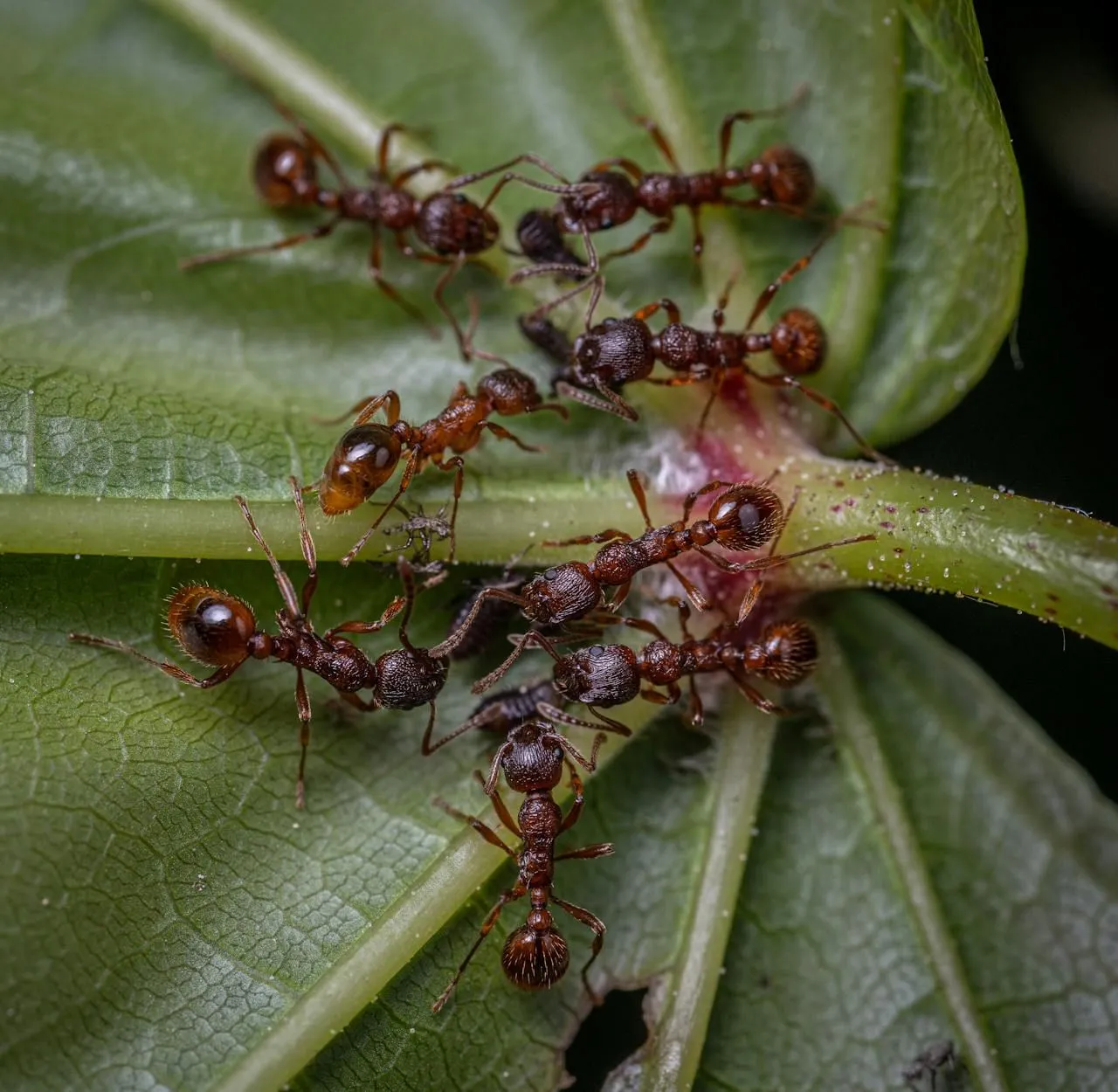
The most common harmful ant-tree interaction in temperate gardens is aphid tending. Ants protect aphid colonies from predators and parasitoids, farm them for honeydew, and move aphids to new plant growth to optimize production. This protection dramatically inflates aphid populations, which can weaken young or stressed trees and ornamental plants.
The relationship is covered in detail in our ants and aphids guide. The short version: if you see ants running up a tree trunk in large, steady numbers, check the undersides of leaves above for aphid colonies.
| Interaction | Effect on Tree | Practical Severity |
|---|---|---|
| Seed dispersal | Positive | Beneficial |
| Soil aeration | Positive | Beneficial |
| Aphid tending | Negative | Moderate — depends on tree health |
| Wood excavation (carpenter ants) | Negative | Serious in compromised trees |
| Fire ant mounds at root zone | Neutral to minor | Low — access hazard only |
| Predation of bark beetles | Positive | Beneficial |
Carpenter Ant Damage
Carpenter ants nest in trees with internal decay, hollow sections, or moisture-damaged wood. They don't eat sound wood — they excavate galleries in already-compromised material. A mature tree with an established carpenter ant colony almost certainly has a pre-existing decay problem; the ants are a symptom, not the primary cause.
That said, carpenter ant excavation accelerates structural weakening and can significantly hollow out branches or trunk sections, increasing the risk of limb failure over time. A large colony in the main trunk of a shade tree near a home, walkway, or play area is worth taking seriously from a safety standpoint.
Scale Insects and Other Honeydew Producers
Ants don't limit their farming activity to aphids. Soft scales, mealybugs, and whiteflies all produce honeydew that ants actively protect and exploit — the dynamic is identical to aphid farming. Ants guard these colonies from natural predators, maximizing honeydew production at the cost of the tree's health.
On citrus, magnolia, and ornamental trees in Florida and along the Gulf Coast, scale insect populations protected by ants can build to levels that cause leaf drop, twig dieback, and sooty mold across large sections of the canopy. The same trunk barrier approach used against aphid-tending ants works equally well here — preventing ant access breaks the protection umbrella that allows scale populations to build unchecked.
According to UF IFAS Extension, combining a trunk barrier with a horticultural oil or insecticidal soap spray to the scale colony itself resolves most infestations faster than either method alone. Once ants are excluded from the canopy, natural predators and parasitoids typically reduce scale populations within two to three weeks without additional intervention. See our ants in the garden guide for how this same dynamic plays out across smaller plants and shrubs.
Fire Ant Mounds at the Root Zone
Fire ant mounds built at the base of trees or in the root zone don't directly harm the tree. They do create a hazard for anyone working near the tree and may affect shallow feeder roots in a narrow zone. Treating mounds near trees with a labeled mound drench or direct mound treatment is appropriate when the location creates a sting risk.
How to Manage Ants on Trees
For Aphid-Tending Ants
The most effective approach is a sticky barrier applied around the tree trunk. Tanglefoot or a similar sticky compound applied to a wrap of tape or foam around the lower trunk prevents ants from climbing to the aphid colonies above. Without ant protection, aphid populations decline rapidly because natural predators — ladybugs, lacewings, parasitic wasps — can now reach them.
Alternatively, treating the aphid colony directly with insecticidal soap or a forceful water spray reduces the colony ants are tending, eliminating the reason for heavy trunk traffic without touching the ants at all.
For Carpenter Ants in Trees
If a tree shows signs of internal decay and carpenter ant activity is confirmed in the trunk or major branches, have a certified arborist assess the structural integrity before deciding on treatment. A tree that poses a fall risk needs professional attention regardless of the ant situation. For trees deemed structurally sound with localized excavation, a residual insecticide applied into galleries and around the base can suppress the colony.
For Ants Traveling to Your Home Via Trees
Tree branches touching the roofline, soffit, or exterior walls create ant highways into your structure. Trimming branches so they don't contact the home — maintaining at least 12 inches of clearance — eliminates this entry route without any chemical treatment. This is standard advice across both carpenter ant control and general ant prevention, and it's worth doing before anything else.
According to UF IFAS Extension, removing tree-to-structure contact is one of the most effective single actions homeowners can take to reduce carpenter ant pressure on buildings in Florida, where several large Camponotus species are common.
In my 15 years of pest management work, the most common ant-and-tree scenario isn't carpenter ants in a decaying trunk — it's a perfectly healthy tree with branches touching the soffit, acting as a bridge for odorous house ants, Argentine ants, or carpenter ants into the home. The fix takes ten minutes with a pair of loppers and solves the problem more permanently than any chemical treatment. I tell every client: if there's a branch touching your house, cut it back before we do anything else.
Ants and trees have coexisted for tens of millions of years, and most of that relationship is neutral or beneficial. Intervention is only warranted when specific damage mechanisms are active and significant — and the first question to ask is always whether you're actually looking at a problem or just ants being ants.
Prevention
Prevent ants from using trees as bridges into your structure by trimming all branches so no part of the canopy touches or overhangs the roofline, walls, or gutters. Maintain a clearance of at least two feet between tree canopy and the building exterior. Apply a sticky barrier product such as Tanglefoot to a paper tape wrap around tree trunks to prevent ground-nesting ants from climbing into the canopy. Address aphid colonies on trees early each spring with insecticidal soap or neem oil to eliminate the honeydew supply that draws ants upward and toward the structure. Inspect tree wounds, hollow sections, and damaged bark annually: carpenter ants preferentially nest in wood weakened by fungal decay, so treating wounds with an appropriate sealant and addressing root moisture problems reduces establishment risk in valued landscape trees.
Main Causes
Indoor ants activity typically traces to outdoor colonies in mulch beds, lawn soil, decking voids, or wall cavities near the foundation. Scouts enter through gaps under doors, foundation cracks, utility penetrations, and damaged weatherstripping when food residue, water from leaks, or warmth from heating runs is available inside. Pheromone trails reinforce within hours of a successful foraging trip, drawing dozens to hundreds of workers along the same route. Heavy rain, drought, or disturbance to an outdoor nest pushes whole colonies inside in pulses. Sweet residue on counters, unsealed pantry items, pet food bowls left out overnight, and leaking pipes are the most common triggers, and the closer an outdoor colony sits to the structure, the harder the pressure becomes to manage.
How to Identify
Confirm ants are present by tracking activity rather than relying on a single sighting. Look for steady two-way trails along baseboards, counter edges, window frames, and utility penetrations, and follow the trail back to where it enters the structure. Size, color, and antennae shape distinguish the species: tiny dark ants attracted to sweet residue are usually odorous house ants or Argentine ants, large black ants near sawdust point to carpenter ants, tiny pale yellow ants scattered throughout a building indicate Pharaoh ants, and red dome mounds outdoors signal fire ants. Place a drop of honey or peanut butter near suspected activity and check at thirty minutes; aggregation around the bait confirms the species and food preference.
Risk and Severity
Risk varies sharply by species. Carpenter ants tunnel into structural wood and can cause meaningful damage if a colony goes unaddressed for years, particularly in moisture-compromised framing. Pharaoh ants contaminate food and medical supplies and are documented carriers of pathogens in hospital settings. Fire ants pose direct stinging hazards to children, pets, and anyone with venom allergy, with rare but serious anaphylactic reactions documented. Most nuisance species — odorous house ants, Argentine ants, pavement ants — present primarily a food contamination and aesthetic concern rather than a medical or structural one. Severity scales with colony size, proximity to occupied areas, and household members at elevated risk (small children, immunocompromised individuals, anyone with prior anaphylactic reactions to insect venom).
Solutions and Actions
Effective ant control combines bait, perimeter exclusion, and sanitation rather than relying on contact sprays. Identify the species first because bait selection depends on the colony's current dietary preference — sweet baits for odorous house ants and Argentine ants, protein-based or grease baits for thief ants, multi-bait stations for opportunistic species. Place bait stations directly on active trails, not in random locations, and allow workers to carry the slow-acting active ingredient back to the colony untouched — avoid spraying anywhere near bait. Treat outdoor satellite nests within twenty feet of the structure with a non-repellent residual. Seal entry points only after bait has had time to reach the colony, otherwise foragers seal their access while the colony continues producing replacements.
Frequently Asked Questions
Should I remove ants from my trees?
Only if they're actively causing harm — farming aphids that are weakening the tree, or if carpenter ants are excavating a structurally compromised section. Ants foraging up and down a healthy trunk for insects and honeydew are not causing damage and don't need to be removed.
Can ants kill a tree?
Directly, no. Carpenter ants can accelerate decay in an already-compromised tree, and heavy aphid farming by ants can weaken young or stressed trees. A healthy, vigorous tree is not at meaningful risk from ant activity alone.
What is the sticky residue on surfaces under my tree?
You're likely seeing honeydew — a sugary liquid excreted by aphids that ants are tending in the canopy. Honeydew drips from infested branches and may attract other insects and support sooty mold growth on leaves and bark below. Controlling the aphid colony resolves the honeydew problem at the source.
When are ants on a tree a sign of a different pest problem?
Persistent ant traffic up and down a trunk often points to sap-feeding insects such as aphids, scale, or mealybugs producing honeydew. In that case, the tree issue is not the ants themselves but the insects they are protecting and farming.
Continue reading:
The Complete Guide to Ants: Identification, Prevention & Removal →Sources & Further Reading
- Ants — Pest Notes — University of California Statewide IPM Program
- Texas Imported Fire Ant Project — Texas A&M AgriLife Extension
- Controlling Pests Safely — U.S. Environmental Protection Agency