Part of the The Complete Guide to Ants: Identification, Prevention & Removal guide.
Ants are essentially living chemical factories. A single worker can produce dozens of distinct signals from multiple glands across its body, coordinating everything from food location to colony defense to caste recognition. Pheromones are the language of ant society, and understanding how they work explains a lot about ant behavior — including why certain control methods fail spectacularly.
For a comprehensive overview, see our Complete Guide to Ants.
What Are Pheromones?
Pheromones are chemical signals secreted by one individual that influence the behavior or physiology of others of the same species. Unlike hormones (which act internally), pheromones act externally — they're released into the environment and detected by nestmates through olfactory receptors on their antennae.
Ant antennae are extraordinarily sensitive chemical detectors. They can identify hundreds of distinct pheromone signals, distinguish nestmates from non-nestmates by colony-specific chemical profiles, and track concentration gradients to follow trails. According to Cornell University, pheromone communication in ants is one of the most sophisticated chemical signaling systems in the animal kingdom.
Types of Ant Pheromones
Trail Pheromones
Trail pheromones are the most familiar ant chemical signal. When a forager finds food, it returns to the nest while periodically touching its gaster (abdomen) to the ground, depositing small quantities of pheromone. This marks a path that other foragers follow by keeping the chemical concentration centered under their antennae.
Trail pheromone systems are self-reinforcing: more ants using the trail means more pheromone deposited, which attracts more recruits, which deposits even more pheromone. This positive feedback loop explains why a single crumb on a countertop can produce a stream of hundreds of ants within minutes. Conversely, when a food source is depleted, workers stop reinforcing the trail, pheromone evaporates, and the trail fades naturally.
Alarm Pheromones
When an ant is disturbed, injured, or encounters a threat, it releases alarm pheromones from the mandibular or Dufour's gland. These signals operate at two concentrations:
- Low concentration: Attract nearby workers to investigate the area.
- High concentration: Trigger aggression and defensive behavior across the colony.
This is why stepping on one fire ant can cause dozens more to sting you immediately — the crushed worker releases alarm pheromone that recruits nestmates into attack mode. The behavior is highly adaptive for colony defense but can turn a minor disturbance into a mass attack.
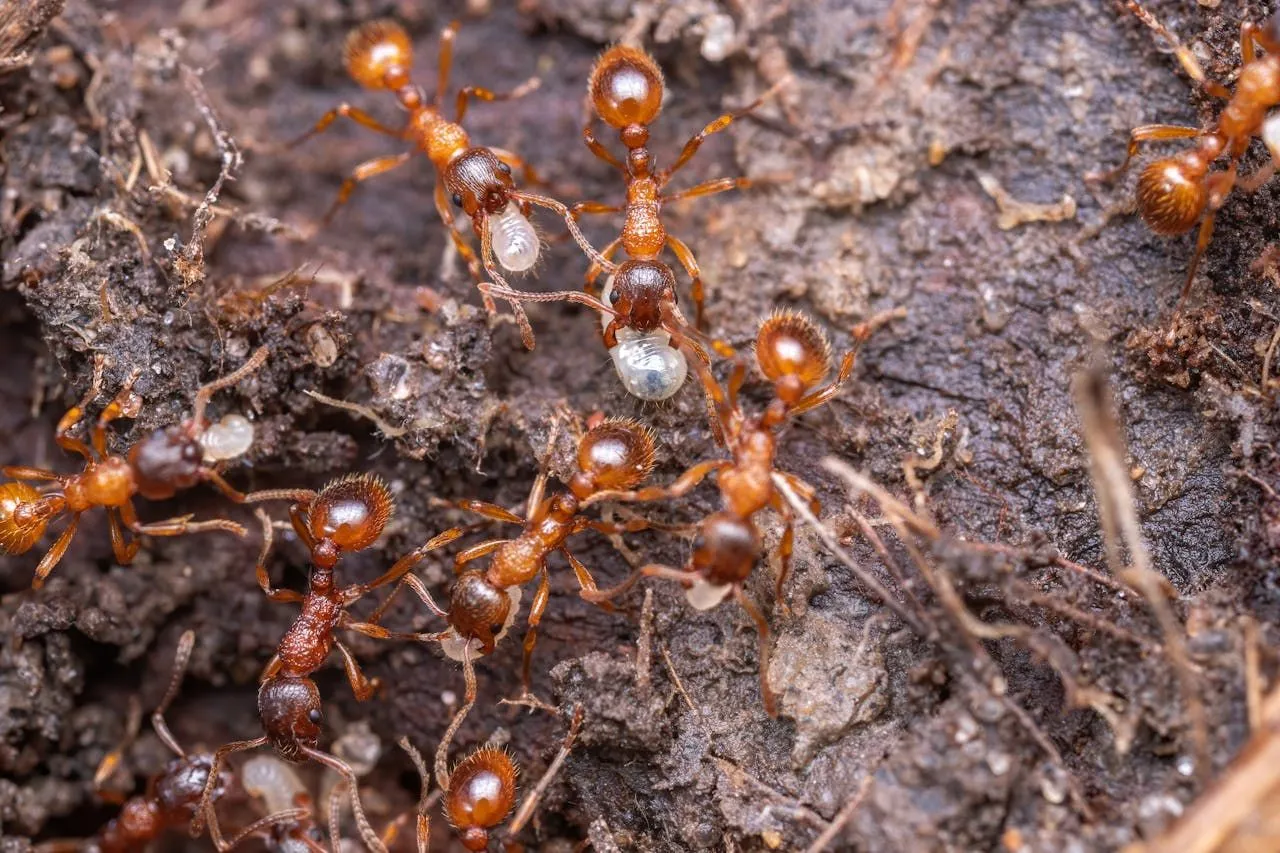
Queen Pheromones
Queens produce specific chemical signals that regulate worker behavior and maintain colony cohesion. Queen pheromones suppress reproductive development in workers (preventing them from laying viable eggs), signal the queen's presence and health, and influence brood care behavior in nurse workers.
When a queen dies or is removed, the absence of queen pheromone triggers rapid changes: workers begin laying unfertilized eggs (typically males), and in some species, the colony attempts to raise a new queen from existing larvae. This is the mechanism behind colony collapse when pest control treatment successfully eliminates the queen — without her pheromones regulating the workforce, the colony unravels.
Recruitment Pheromones
Distinct from trail pheromones, recruitment pheromones are released to rapidly mobilize large numbers of workers for a specific task — defending against a threat or exploiting a large food source. Some species use volatile recruitment pheromones that disperse quickly through nest chambers, rousing workers from rest states throughout the colony.
Cuticular Hydrocarbons: Chemical Identity
Ants recognize nestmates through a complex mixture of hydrocarbons on their cuticle (exoskeleton surface). Each colony has a distinctive chemical profile, and workers quickly identify intruders by their foreign cuticular chemistry. This is why introducing ants from different colonies into the same container triggers immediate aggression — they smell wrong.
| Pheromone Type | Source Gland | Primary Function |
|---|---|---|
| Trail pheromone | Poison gland, hindgut | Food and nest navigation |
| Alarm pheromone | Mandibular, Dufour's | Defense, danger signaling |
| Queen pheromone | Various | Reproductive suppression |
| Recruitment pheromone | Various | Mass mobilization |
| Cuticular hydrocarbons | Cuticle surface | Colony identity recognition |
How Pheromones Explain Common Control Failures
Understanding pheromone dynamics clarifies several frequent control failures:
Why wiping trails with repellent sprays doesn't work: Sprays kill visible foragers and disrupt the pheromone trail, but the colony simply finds a new route within hours. The colony itself is unaffected.
Why killing visible ants doesn't solve the problem: Worker ants are expendable. A large colony can replace hundreds of killed workers without any reduction in overall population. The queen must be eliminated.
Why disturbing nests with repellents backfires: Alarm pheromone released when workers are killed can trigger budding behavior in polygyne species like pharaoh ants and ghost ants. The colony interprets a spray attack as a fatal threat and splits to preserve its queens.
Why bait works: Slow-acting baits are carried back to the nest as food and shared through trophallaxis and brood feeding, eventually reaching the queen. The colony's own food-sharing behavior — coordinated by pheromones — delivers the active ingredient precisely where it matters.
According to UF IFAS Extension, pheromone research has directly informed the development of modern ant baits, particularly the understanding that colony-level suppression requires disrupting the queen's reproductive cycle, not just eliminating surface workers.
Nuptial Flights and Reproductive Pheromones
Pheromones also govern one of the most visible ant behaviors: the nuptial flight. When a colony matures and conditions are right — typically warm temperatures following rainfall — the queen releases reproductive pheromones that trigger the development and release of alate (winged) reproductive forms: new queens and male drones.
The timing of nuptial flights is coordinated colony-wide by these chemical signals. Workers create exit holes, alates begin climbing to elevated launch points, and the swarm emerges in a matter of hours. The environmental trigger (warmth, humidity, post-rain air pressure change) combines with internal pheromone signals to synchronize emergence across many colonies in the same area simultaneously — which is why swarms often appear in the same neighborhoods at the same time.
After mating, male drones die quickly and fertilized queens shed their wings, a behavior cued by pheromone changes following mating. The newly mated queen then searches for a nest site, using chemical senses to assess soil chemistry, humidity, and proximity to food sources.
Understanding this process clarifies what you're seeing when you find flying ants inside your home. The swarmers aren't searching for food — they're reproductive individuals following pheromone and environmental cues toward light and open air. Their presence means a mature colony is nesting somewhere close by.
The NPMA notes that nuptial swarms are the most common reason homeowners first notice they have an ant infestation — the foraging workers had been present for weeks or months, but the swarm makes the colony impossible to ignore.
Practical Takeaways for Pest Control
- Follow the trail, don't destroy it: Ant trails lead back to the colony. Tracing a trail to its source is the fastest way to locate the nest for direct treatment. See how to find an ant nest.
- Place bait on active trails: Workers in food-collecting mode will recruit heavily to bait placed along the trail.
- Don't spray near bait stations: Insecticide residue contaminates bait, making it chemically unacceptable to foragers.
- Use the system against the colony: Bait exploits the pheromone-driven food-sharing network — let the ants distribute the active ingredient for you.
In my 15 years of pest management work, I've found that explaining ant pheromone trails to homeowners changes everything. Once they understand why spraying the counter doesn't fix the problem — and why following the ants is more useful than killing them — they're patient with bait. The pheromone system is working for the colony at full efficiency. With the right strategy, you can make it work against them.
How to Identify
Pheromone activity is not directly visible, but its effects are. A well-defined, consistent ant trail following the same path day after day indicates an active pheromone highway. When you wipe a trail clean with soapy water or vinegar, watch to see if new ants reestablish the same route within hours: that reformation confirms chemical signaling is actively guiding workers. Alarm pheromone responses are identifiable when disturbing a nest causes rapid, agitated scattering rather than orderly retreat, and when nearby ants suddenly orient toward the disturbance. Steady aggregation around a food source that grows from a few ants to dozens within 30-60 minutes of a scout's first visit shows successful recruitment pheromone function.
Risk and Severity
Pheromone communication makes ant infestations self-reinforcing. A single scout finding food lays a trail that recruits hundreds of workers within hours. Alarm pheromones coordinated by fire ants drive mass stinging attacks, elevating injury risk whenever a mound is disturbed. Queen pheromones that suppress reproduction in workers explain why multi-queen species like pharaoh ants and Argentine ants are so difficult to eliminate: the distributed chemical signaling system makes the colony resilient to partial queen loss, allowing rapid recovery from incomplete treatment. Pheromone trails persist on surfaces for hours to days, meaning surviving ants quickly re-establish the same routes even after visible foragers are treated.
Prevention
Disrupting pheromone trails is a practical, if temporary, prevention tactic: clean ant trails with soapy water or a 1:1 white vinegar and water solution to remove chemical signals that recruit more workers. However, trail disruption alone does not address the colony. Combine it with bait placement on active trails and sanitation to remove the food source that initiated scouting. Prevent alarm pheromone dispersal by treating fire ant mounds early and avoiding direct nest disturbance without appropriate protective gear. Apply perimeter insecticides as a barrier that foraging scouts encounter before they reach the interior, preventing trail establishment inside the structure in the first place.
Main Causes
Indoor ants activity typically traces to outdoor colonies in mulch beds, lawn soil, decking voids, or wall cavities near the foundation. Scouts enter through gaps under doors, foundation cracks, utility penetrations, and damaged weatherstripping when food residue, water from leaks, or warmth from heating runs is available inside. Pheromone trails reinforce within hours of a successful foraging trip, drawing dozens to hundreds of workers along the same route. Heavy rain, drought, or disturbance to an outdoor nest pushes whole colonies inside in pulses. Sweet residue on counters, unsealed pantry items, pet food bowls left out overnight, and leaking pipes are the most common triggers, and the closer an outdoor colony sits to the structure, the harder the pressure becomes to manage.
Solutions and Actions
Effective ant control combines bait, perimeter exclusion, and sanitation rather than relying on contact sprays. Identify the species first because bait selection depends on the colony's current dietary preference — sweet baits for odorous house ants and Argentine ants, protein-based or grease baits for thief ants, multi-bait stations for opportunistic species. Place bait stations directly on active trails, not in random locations, and allow workers to carry the slow-acting active ingredient back to the colony untouched — avoid spraying anywhere near bait. Treat outdoor satellite nests within twenty feet of the structure with a non-repellent residual. Seal entry points only after bait has had time to reach the colony, otherwise foragers seal their access while the colony continues producing replacements.
Frequently Asked Questions
Can I use pheromones to repel ants?
Not practically. While alarm pheromones cause ants to flee, synthetic versions aren't available as consumer products and would require constant reapplication as they evaporate. The most practical pheromone-masking approach is wiping trails with vinegar or citrus as a short-term deterrent. See our guide on vinegar for ants for how well that holds up.
Why do ants follow the exact same path every time?
They're tracking a pheromone trail deposited by previous foragers. Their antennae continuously correct their course to stay centered on the chemical signal — straying off the chemical concentration triggers an immediate correction back toward it.
What happens when you break an ant trail?
Ants temporarily lose the trail and move erratically until they relocate the pheromone concentration. If the food source is still present and valuable, workers typically re-establish a new trail within minutes to hours. Wiping a trail without addressing the food source is only a temporary disruption.
Why do ants follow the exact same trail after I wipe the counter?
A quick wipe may remove visible ants without fully removing the pheromone trail along edges, grout, or tiny surface scratches. Cleaning with soap and water, then correcting the food or moisture source, is more effective than simply killing the ants walking on the trail.
Continue reading:
The Complete Guide to Ants: Identification, Prevention & Removal →Sources & Further Reading
- Ants — Pest Notes — University of California Statewide IPM Program
- Texas Imported Fire Ant Project — Texas A&M AgriLife Extension
- Controlling Pests Safely — U.S. Environmental Protection Agency