Part of the The Complete Guide to Lice: Identification, Types, Treatment & Prevention guide.
Thick, dense hair creates the same challenge lice face everywhere — warm scalp, viable hair shafts — but it creates a much bigger challenge for you: there are simply more places to hide. Pediculus humanus capitis does not care about hair density when selecting a host, but your odds of missing live insects or nits during inspection rise with every additional strand. Understanding why thick hair complicates the process helps you design an approach that compensates.
For a full overview of lice biology, transmission, and treatment options, see The Complete Guide to Lice.
Does Thick Hair Attract More Lice?
Hair density does not influence Pediculus humanus capitis behavior at the transmission stage. Lice transfer through direct head-to-head contact — a louse crawls from one scalp to another when heads are close enough. The density of the recipient's hair is not a factor in whether the louse successfully transfers.
Where density matters is after the louse establishes itself. A thicker head of hair offers more potential attachment sites for nit-laying. A female louse lays three to five eggs per day throughout her 30-day adult lifespan. In thick hair, those nits spread across a higher number of strands, making any given square centimeter less obviously infested — and therefore easier to overlook at the start.
The American Academy of Pediatrics notes that early detection is one of the key factors that reduces treatment burden. In thick hair, early detection requires a more systematic approach.
The Density Problem in Numbers
If a person with thin hair has 60,000 strands and a person with thick hair has 100,000, the same number of nits spread across the thick head is geometrically harder to find — they occupy a smaller percentage of visible strands. For visual checks with a flashlight, this dilution of nit density makes infestations look less severe than they actually are.
Inspecting Thick Hair for Lice
A visual-only check almost always misses live lice in thick hair. Lice move quickly — up to 9 inches per minute — and bury themselves into the understory of dense hair. An effective inspection of thick hair requires both visual examination and a wet-comb pass.
Inspection setup:
- Good overhead light or a lice-detection lamp
- Metal fine-tooth lice comb — not plastic, which skips nits
- Heavy conditioner — enough to create slip across all strands near the scalp
- Section clips to hold processed sections away from unexamined hair
- White paper towels to examine comb contents after each pass
Work from nape to crown, section by section. The full inspection technique covers timing and positioning in detail.
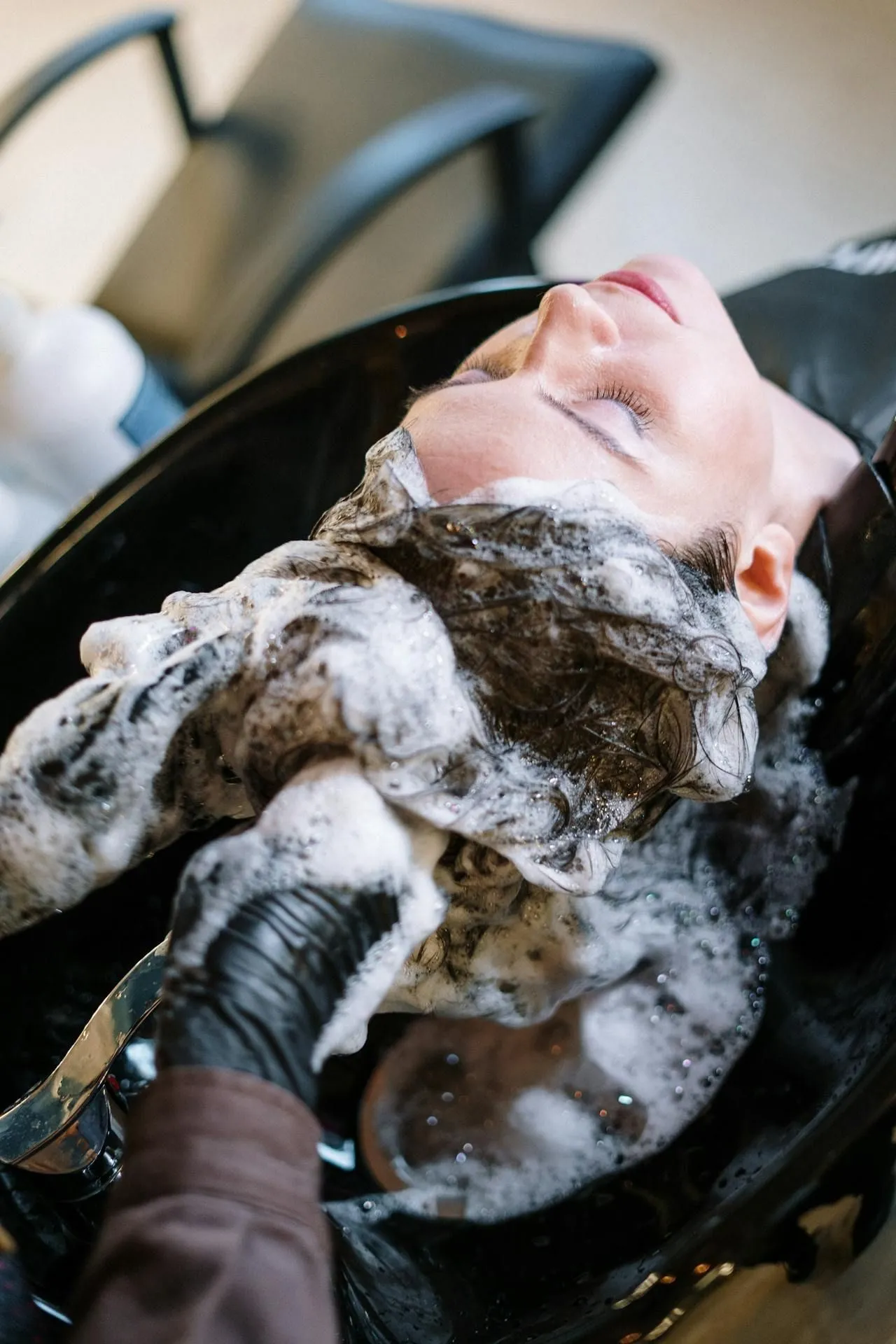
Where to Look First
In any hair type, lice prefer the warmest zones: behind the ears, the nape of the neck, and the crown. In thick hair, focus your earliest attention on these areas because they are where infestations begin. A fresh case will show nits at the base of strands in these zones before the infestation spreads to the full head.
Combing Technique for Thick Hair
Combing thick hair with a fine-tooth metal lice comb requires the same conditioner-heavy sectioning technique used for curly hair, with adjustments focused on managing volume.
| Step | Standard Hair | Thick Hair Adjustment |
|---|---|---|
| Section size | 1-inch wide | Half-inch wide maximum |
| Conditioner amount | Moderate | Heavy; reapply as sections dry |
| Comb passes per section | 3–4 | 5–7 to ensure full depth coverage |
| Time required | 20–30 min | 45–90 min |
| Follow-up interval | Every 3–4 days | Every 3 days for first 2 weeks |
The extra time is unavoidable. Rushing the comb through large sections in thick hair means live lice slip past the tines. A fine-tooth metal comb catches nits at 0.3 mm spacing — but only if it makes contact with the strand they're attached to.
Use section clips liberally. Pin each completed section away from the work area so combed hair can't re-mix with unexamined hair during the session.
See lice comb technique for step-by-step guidance.
Applying Treatment to Thick Hair
Pediculicide effectiveness depends entirely on scalp and hair-strand saturation. In thick hair, insufficient product application is the most common reason treatments fail. This is not a resistance issue — it's a coverage issue.
Permethrin 1% (OTC) is designed to saturate hair from scalp outward. The instructions typically specify applying to clean, towel-dried hair. For thick hair, use the entire bottle if needed — a treatment that barely wets the surface layer of thick hair is not reaching the insects and nits living close to the scalp.
Volume requirements by hair length and density:
- Fine or thin hair, shoulder length: one standard bottle often sufficient
- Thick hair, shoulder length: one to two bottles
- Thick hair, past-shoulder length: two bottles minimum
Prescription options like benzyl alcohol lotion or ivermectin lotion may offer advantages for thick hair because their formulations are engineered to penetrate to the scalp rather than coat the shaft surface. If OTC treatments fail after two correctly administered applications, ask a physician about prescription alternatives.
In my 15 years of pest management in central Florida, the most common callback I get after a household lice treatment is from families where one child has dense, thick hair and the parents used the same amount of product they used on their other children with thinner hair. Thick hair requires proportionally more product, more time, and more follow-through. It is not harder to treat — it just requires more of everything.
Environmental Cleanup for Thick-Hair Households
Lice survive a maximum of 24–48 hours off a human host. Environmental decontamination is supporting — not primary — treatment. The Environmental Protection Agency cautions against excessive pesticide use in the home for lice control, as environmental sprays are unnecessary and add chemical exposure without benefit.
Focus environmental steps on:
- Bedding and pillowcases — wash on hot cycle (≥130°F), dry on high heat
- Hats, helmets, and headbands — wash or seal in plastic bag for 48 hours
- Brushes and combs — soak in hot water (≥130°F) for 5–10 minutes, or seal in bag for 48 hours
- Car headrests — vacuum
Lice cannot burrow into carpet or upholstery for extended periods. Vacuuming regularly-used seating is reasonable; spraying furniture with pesticides is not warranted.
Preventing Reinfestation in Thick-Haired Household Members
After clearing an infestation, thick hair requires the same prevention approach as any other hair type. Lice prevention is about behavioral changes — reducing head-to-head contact — not about treating hair with deterrent products.
Check lice in long hair as a companion if length adds another layer of complexity to your situation, since long, thick hair combines both density and length challenges simultaneously.
Periodic wet-comb checks — once a week during an active school outbreak, or once after any known exposure — catch re-infestations before they become established. In thick hair, a quick visual check alone is not reliable enough to declare clearance.
Thick hair does not make lice treatment impossible, but it does require more product, more time, and more methodical technique. A half-inch sectioning approach, sufficient conditioner, and multiple comb passes per section are the practical adjustments that bridge the gap between a missed case and a resolved one.
Main Causes
Lice infest thick hair for the same reason they infest any hair: direct head-to-head contact with an infested person. Lice are obligate human parasites that cannot survive more than 24 to 48 hours away from the scalp. They transfer during the brief moments when hair from two people touches. Thick hair does not cause or attract lice, nor does it confer protection against them. However, dense hair provides more surface area, more nit attachment sites, and better cover for adult lice, which can allow an infestation to grow larger before it is detected. Sharing combs, hats, helmets, and hair accessories is a secondary transmission route. Individuals with thick hair in high-contact environments -- schools, childcare settings, sports -- carry the same transmission risk as anyone else. Personal hygiene and hair cleanliness do not determine lice risk.
Risk and Severity
Thick hair creates practical challenges that can increase the effective severity of an infestation. Dense hair provides more hiding space for adult lice and more attachment sites for nits, so infestations may grow larger before obvious symptoms appear. Thorough treatment application is harder to achieve in thick hair, raising the chance of missed lice or nits during both chemical application and combing. Treatment products such as lice shampoo may need to be applied in larger quantities to fully saturate thick hair, increasing cost and chemical exposure. Combing sessions are longer and more laborious. Despite these practical challenges, the medical risks of lice infestation -- itching, sleep disruption, secondary skin infection from scratching -- are the same regardless of hair density.
Prevention
Preventing lice in thick hair uses the same strategies as prevention in any hair type. Head lice spread through direct head-to-head contact, so avoiding that contact during school, sports, and social activities is the primary strategy. Do not share combs, brushes, hats, or hair accessories. Long, thick hair worn braided, twisted, or pinned up during high-risk periods reduces the exposed surface area available for lice to transfer to. Perform lice checks every one to two weeks during active school outbreaks; for thick hair, a methodical section-by-section wet comb is essential since visual inspection alone will miss lice hidden in dense strands. Early detection is especially important for thick hair because infestations can grow large before they become obvious. See our lice prevention guide for a complete protocol.
How to Identify
Reliable identification requires a wet comb examination rather than a visual scan. Saturate the hair with conditioner, then draw a fine-toothed metal lice comb from scalp to tip in small sections, wiping the comb on a white paper towel after each pass and inspecting under good light. Adult lice are two to three millimeters long, tan to grayish-white, and move quickly. Nits are pinhead-sized cream-yellow ovals cemented to the hair shaft within a quarter inch of the scalp; they do not slide off when pushed, distinguishing them from dandruff and product residue. Itching may be absent for the first four to six weeks of an infestation, so combing rather than waiting for symptoms is the proper diagnostic step.
Solutions and Actions
Eliminate head lice through a treat-and-comb protocol rather than any single application. Apply a pediculicide labeled for head lice (over-the-counter permethrin or pyrethrin products are first-line; prescription options exist for treatment-resistant cases). Critically, repeat the application at seven to ten days to catch nymphs that hatched from eggs surviving the first treatment — skipping this second application is the most common reason treatments fail. Combine medication with daily wet combing using a fine-toothed metal lice comb, applying conditioner and combing in sections, for at least two weeks. Wash and dry recently used bedding and clothing on high heat. Bag stuffed animals and headgear that cannot be washed for two weeks. Check all household members on the same day and treat anyone positive.
Frequently Asked Questions
Can lice hide deep in thick hair near the scalp?
Yes. Lice and nits concentrate near the scalp where warmth is greatest. In thick hair the understory of strands near the scalp is particularly dense, requiring very small sections and thorough combing to reach these areas.
Should I use more than one bottle of lice treatment on thick hair?
Often yes. Adequate saturation of the scalp and all hair strands is required for pediculicides to work. Thick hair typically requires more product than a single standard bottle provides.
How long does combing take for thick hair?
Plan for 45 to 90 minutes for a thorough wet-comb session on thick hair, versus 20 to 30 minutes for fine hair. Cutting the session short is the most common reason nits are missed.
Is a quick visual check enough to confirm thick hair is lice-free?
No. Thick hair can hide both moving lice and nits near the scalp, especially behind the ears and at the nape. A wet-comb check with conditioner is much more reliable because it physically samples the dense lower layers that a flashlight inspection may miss.
Should thick hair be cut short to make lice treatment work?
Cutting hair is not necessary. Shorter hair may reduce combing time, but lice treatments work when the scalp and hair are fully saturated and combing is thorough. Small sections, enough product, and repeated follow-up checks matter far more than hair length.
Sources: American Academy of Pediatrics, Environmental Protection Agency
Sources & Further Reading
- Head Lice — Health Topic — U.S. Centers for Disease Control and Prevention
- Treating and Preventing Head Lice — U.S. Food and Drug Administration
- Head Lice Clinical Report — American Academy of Pediatrics